The Turkish getup, along with the kettlebell swing, forms the foundation of HardStyle kettlebell training. It is, however, a tricky exercise to master –
1. Start the move lying on your side with the kettlebell at your shoulder. Pull the ‘bell into your frame, roll to your back, and punch the KB up towards the ceiling.
2. If you are on your right side, your right heel will be tucked up to your right glute. Your left leg will go out slightly at an angle along with your left arm.
3. Now, drive through the right heel and punch up towards the ceiling. Straighten out the bottom arm so you are supporting your weight with your bottom arm completely outstretched.
4. Drive the hips towards the ceiling, come up to a bridge position, and bring the foot through the hips. Shoot to get the knee that’s coming thru to land right by the hand that’s on the ground.
5. Come up to your lunge position and get set. Brace the abs, make sure the bicep is directly by the ear and the shoulder supporting weight of kettlebell is tight and stabilized. Stand up!
I hope this video helps you refine your technique in the tricky-to-master kettlebell Turkish Get Up exercise. Talk to you soon –
Forest
P.S. To learn more about the Kettlebell Basics Premium Workout Mega Bundle I mentioned earlier in the article, click here
P.P.S. If you’d like to get kettlebell training tips and tricks like this one delivered to your email inbox every week – AND get a free copy of my Beginner’s Guide to Kettlebell Training – please sign up for my email newsletter by dropping your name and best email into the box at the upper right hand corner of the page!
The kettlebell snatch is great exercise, but learning good technique can be tricky. Today’s post is the last in a three-part series on Mastering the Kettlebell Snatch.
In part one of the series, we talked about the lockout phaseof the movement. In part two, we covered the downswing. Now, in today’s final installment, we’ll cover the upswing.
Here’s a video that covers part three in detail – watch it first:
Video Recap
We’ve now progressed to performing a full kettlebell snatch. We’ll start with the ‘bell about one foot in front of us (the same set up as a swing).
To start the move, hike pass the weight back – again, the same ‘start’ as the swing. But, instead of swinging the weight in front of you and up to shoulder height, we’re going to go straight overhead with the move into a snatch.
Remember:
The arc of snatch is much closer to the body than the swing.
And so to drill this idea down, we’ll perform the following progression:
Three one-hand swings.
Three high pulls – try to make the ‘bell ‘float’ at the top by pulling the elbow back and snapping the hips simultaneously.
Three snatches. The snatch will simply be an extension of the high pull. The weight floats at the top during the high pull, and then we get our hand around the ‘bell to finish the snatch.
Again, perfecting your form on the kettlebell snatch takes work. If you’re having trouble learning the movement or if you’re just looking to refine your form, go through the three step learning progression I’ve outlined in this article and video series. Good luck and keep training hard!
P.S. Signed up for my weekly newsletter yet? You’ll get my Beginner’s Guide to Kettlebell Training when you do so, along with tips and tricks just like these delivered straight to your e-mail inbox each and every week. Just drop your best e-mail and name into the box at the upper right of the page to sign now!
Back today with part two of my ‘Mastering The Kettlebell Snatch’ video series –
First, watch the video:
Video Recap
If you remember, part one of mastering the snatch is the lockout (by the way, be sure to read part one of this post series and watch the video if you haven’t yet – you can do that by clicking here).
Part two of mastering the kettlebell snatch is the downswing. Here are your coaching points:
To start the downswing phase of the snatch, from your overhead lockout position, think about closing the distance from the elbow to the rib cage as fast as possible to bring the kettlebell down.
The arc of the snatch is much closer to the body than the arc of the swing.
Another good coaching point for this part of the snatch is to think about throwing the kettlebell through the stomach.
If you were to take a snapshot of the kettlebell at the bottom position, it would look identical a one arm swing (another reason why it’s so important that you master the HardStyle swing before moving on to more advanced drills like the snatch).
Work on perfecting your snatch downswing, and I’ll catch you next time when we cover the third and final component to mastering the Snatch: The upswing!
Forest
P.S. The kettlebell snatch is a key exercise in a ‘premium’ package of smokin’ kettlebell combos (workout manual and video kettlebell training program) I have coming for you in just a couple of days … if you’re interested, keep an eye on your email inbox for details! I’ll be sending out a message as soon as it’s available.
The kettlebell snatch is a highly technical move. But taking the time to master it is well worth it – you’ll have a great exercise under your belt for power generation, world-class conditioning, and a whole lot more.
Over the next few blog posts, I’m going to teach you the three most important elements you need to learn to master the kettlebell snatch. In part one (this post), we’re going to cover the lockout.
First, watch this short video – it covers this first ‘phase’ of the learning process and some tips on how to practice:
Video Recap
You’ll start with a kettlebell between the feet in a sumo deadlift position. Cheat curl the ‘bell up to your shoulder and press it up over your head. All we’re trying to do is get comfortable with our overhead lockout position.
The bicep should be right by the ear. A common mistake is to hold the ‘bell slightly in front of the body. If you lack proper shoulder mobility, this is likely going to be a problem for you (all the more reason to practice your Turkish getups).
A great drill to practice and get comfortable in this lockout position is an overhead walk. To perform this drill, you would simply get the KB pressed over your head and walk around the room with it. If your elbow is bent, or the kettlebell is out in front of you too far, this is nearly impossible – and that this drill is very self-correcting is part of the beauty of it.
Developing a great lockout is critical to mastering the kettlebell snatch; with tips covered this article and video, you’ll have it down in no time. Practice what we talked about today, and I’ll see you next time for part two in mastering the kettlebell snatch series!
P.S. Don’t forget – if you want a complete guide to mastering the basics of kettlebell training – including the snatch – check out the KettlebellBasics.net Quick Start Guide by clicking here
P.S. Signed up for my weekly newsletter yet? You’ll get kettlebell training tips and tricks like the ones covered in this article and video delivered straight to your e-mail inbox every week – plus, I have a special kettlebell training video and beginners guide FREE for new subscribers! Just drop your name and best e-mail into the box at the upper right of the page to sign up now!
In the last 24 months or so, KettlebellBasics.net has featured:
Well over 150 blog posts
At least as many weekly email newsletters
Several original kettlebell training ebooks and video courses
A kettlebell-themed clothing line
And much more …
So naturally, one of the questions I get most from new readers (and long-time readers alike) is where the heck to start!
This post is going to provide a starting point for this kettlebell blog – even if you’ve been reading my posts regularly for a while, chances are there’s some things I mention in this post that you may have missed that could be of some value in your kettlebell training. Let’s get started!
Where to Start
If you’re brand new to kettlebell training – or you’re still learning the basics – start with my ‘Best Of’ posts. You can find these on the right sidebar from any page on the blog … you’ll find in these posts a ‘directory’, if you will, of kettlebell exercises, kettlebell routines, and kettlebell videos.
The Weekly Newsletter
If you like my ‘Best Of’ series, you’ll love my weekly kettlebell newsletter. You get two free bonuses when you sign up – ‘Kettlebell Rx: 3 Training Mistakes And How To Fix Them’ (a KB training video) AND a copy of my ‘Beginner’s Guide To Kettlebell Training’ (e-manual). Plus, you’ll get weekly email updates from me with new kettlebell workouts, videos, and training tips.
Programs + Products
Next stop is the programs and products page. You can access this page from anywhere on the blog, too … it highlights my series of paid products that’ll help you make even faster progress towards your kettlebell training goals ….
The Kettlebell Basics Swing Manual is the ‘basic’ guide that teaches you the foundation of HardStyle kettlebell training. This is where you should start.
The KettlebellBasics.net Quick Start Guide is an all-inclusive program that teaches you the five basic KB training moves. It includes both audio and video instruction in addition to an e-manual … it’s a good bet once you’ve finished the Swing Manual, or if you’re just ready to jump in right away.
My Kettlebell Basics Premium Workout Series is designed to help you take your kettlebell training to the next level; it’s the progressive plan you need to make continued progress with your training.
The 10×10 Kettlebell Solution is a brand new workout program designed to help you gain lean muscle, torch body fat and transform your body in just 10 weeks, using just 10 exercises and 10 workouts.
Finally, if you’re looking for additional KettlebellBasics.net – approved kettlebell resources, look here. You’ll find recommendations for the best brand of kettlebells, interval timers, Dragon Door books and DVD’s, and much more. You can find this page too at the top of this blog at any time.
So there you have a kettlebell blog overview – the best of KettlebellBasics.net. Whether you’re brand new to the blog or you’ve been around a while, take some time and check out the resources I’ve listed here . There’s enough free info here to last you a long time and give you a great kettlebell training foundation … and, if you’re so inclined to save yourself some time and hassle, I’ve got an array of paid products to help you, too.
Here’s the third and final installment of the Kettlebell Swing Mistakes and Fixes series – in this one, I’ll cover how to fix the common range of motion problem I see in the kettlebell Swing. If you missed the first two posts in this series, make sure to check those out, too – I’ll provide links to them at the end of this article.
As I discus in the video below, the Swing mistake here is not getting the ‘bell far enough back as the weight comes down between the legs and is ‘hike passed’ back:
The fix to the mistake discussed in the video is to think about getting the bottom of the ‘bell to face the wall behind you as it comes down and back. This will allow a larger range of motion and enable you further to ‘pull’ on the KB, thus the ability to generate more force – resulting in a more powerful Swing.
The second fix to this problem (that I don’t cover in the video above) is the towel drill. What you’d do is assume the bottom position of the Swing with a towel in your hands instead of a kettlebell. You need a towel about 18-24 inches long, and you should be grabbing in the middle of the towel so the ends are hanging down loose. Freeze in this bottom-of-the-Swing position, and then either have a partner grab the towel from the back, or loop the towel around something directly behind you to anchor it. Take a small step forward to put tension on the towel – and get the ‘feel’ for that ideal Swing position.
In summary, the third kettlebell Swing mistake is quite simply improper range of motion. The fix mentioned in the video above, as well as the towel drill, are two solutions to this problem. Encorporate these two drills into your kettlebell Swing practice to improve your form today – and keep training hard!
P.S.S. Signed up for my weekly newsletter yet? You’ll get new kettlebell workouts, videos, and training tips delivered straight to your email inbox when you sign up … just enter your name and email address into the box at the upper right of the page to do so today!
I’m going to cover another common mistake with the kettlebell Swing and how to fix it in today’s article; but first, a quick personal story that I think illustrates really well the idea (covered in part one of this post series) of learning a skill correctly the first time:
During my football career, a typical ‘work’ day in the off-season consisted of a workout, a no-pads practice/ walk-thru type session, and maybe watching a little film – we were done for the day by one or two pm. I had more free time on my hands than I do these days – so a few times a week, I’d fill my afternoon by playing golf.
Since I started working ‘for real’ (although I still don’t consider what I do for a living ‘real work’) about six or seven years ago, I haven’t played much golf at all. But business is good, my systems are getting dialed in and I’m starting to get a little extra free time to actually do some fun stuff – so I’m getting back into it. And this time, I want to learn the right way.
That being said, I decided to take a few lessons – and it turns out my golf swing is totally jacked up. By learning the wrong way and developing bad habits the first time around, it’s going to take much longer to fix than if I had taken the time to learn things right from the beginning.
Point is – if you’re still at this beginning learning phase (like I am in my golf game) with your kettlebell training, do yourself a favor and take the time to learn the right way now – you’ll save yourself a lot of wasted time and effort in the long run.
Now – on to Kettlebell Swing mistake #2:
This mistake involves a Squat and Front Raise Pattern – vs. the correct ‘hip-driven’ Swing where the arms account for maybe 10-20% of the movement.
Here’s a video where the demonstrator is attempting a kettlebell Swing (although they’re actually using a dumbbell) – but from a movement perspective, it’s a great example of what not to do (sorry man, I don’t know you, no offense – your Swing instruction just kinda sucks 🙂 ):
So, to fix this:
1. Think of ‘hike passing’ the ‘bell behind you as it comes back
Instead of squatting down and raising the kettlebell up in front of you, think about hiking it back and snapping it up. The bottom of the ‘bell should actually face the wall behind you or pretty close to it when the KB is hiked back.
2. Think of the arms like ropes
The lower body is what drives the movement; the arms, in a way, are just ‘along for the ride’. A good drill to perfect this is the towel Swing from Enter The Kettlebell. You just do your two handed Swings with a towel wrapped around the horn of the ‘bell and grabbing the ends of the towel; to maintain tension on the towel through the entire movement, you have to use your hips and direct energy efficiently to the ‘bell. It’s a great drill because it’s very self correcting.
Remember, learning a new skill the right way the first time around will save you a lot of wasted time and effort in the long run. This applies as much to the kettlebell Swing as it does to any other skill; and one of the most common mistakes with the kettlebell Swing is the Squat and Front Raise error. Take the tips in this article to correct this common flaw – and I’ll see you next time with the final installment of the ‘Kettlebell Swing Mistakes And Fixes’ series!
P.S. My new monthly kettlebell workout membership program is almost finished – the first month’s workout is written up and filmed, and we’re putting together all the final touches right now to make sure the program is even better than advertised. Keep an eye on your email inbox for details – and make sure to sign up for my weekly newsletter if you haven’t yet to get first news of when we open the program up to the public!
The industry standard research that experts refer to with regards to motor learning comes from a 1991 book called – you guessed it – Motor Learning by Doctors Richard Schmidt and Craig A. Wrisberg. In this book, Dr. Schmidt states with a flurry of charts and studies that it requires approximately 300-500 repetitions to develop a new motor pattern. Conversely, once bad or inadequate habits are already in place, he states it takes about 3000-5000 repetitions to erase and correct a bad motor pattern.
Interestingly, it seems that folks who are starting from a blank slate with kettlebells – who’ve never touched one in their entire life – are actually easier to teach proper technique to than folks who’ve been training on their own for a while and have learned some of the basics incorrectly. I’ve observed this ever since I seriously started using kettlebells in my training practice – and the above research confirms this fact.
The moral of the story: Spend the time to learn your Kettlebell Basics right the first time around, so you can spend more time training and making progress towards your fitness goals than practicing and correcting your technique and trying to avoid injury!
I’m going to take the next couple of posts to address some common mistakes folks make with the exercise that forms the foundation of our HardStyle kettlebell training – the Kettlebell Swing – and how to fix them.
For part one of this Kettlebell Swing Mistakes And Fixes series, start by watching the video below:
The mistake we’re talking about in the video above is lack of full hip extension. If you’re making this mistake, you’re not getting a full application of the power that’s being generated by the lower body during the Swing. Not only will you be weaker, but doing this puts the stress on the wrong muscles and wrong areas of your body.
Here are a few good cues to help you correct this issue:
1. Stand as tall as possible
If you think about standing up as tall as you can at the top of the movement, this will help you fully extend the hips and get full glute activation and application of power.
2. Pinch a coin
Tighten the glutes as hard as you can at the top of the movement. Another way to think about this is at the top of your Swing as the weight comes up, if someone were to kick you in the butt, it would be rock hard, not soft.
A lot of folks have what we call ‘gluteal amnesia’ – they’ve forgotten what it even feels like to activate the glutes. So this ‘body hardening drill’ – where you actually have a partner kick you in the butt while you do a Plank or Sumo Deadlift – is a great way to get a feel for proper glute activation.
3. Pull the knee caps up
Instead of thinking about locking out your knees, you’re going to tense your quads and pull your knee caps up. This will help you again to bring your hips through and effectively transfer that force to your upper body from the lower body.
Remember, it takes roughly 300-500 repetitions of a new motor skill to learn it properly, but it takes 3000-5000 reps to correct it if you learn it wrong. So take the time to learn the Kettlebell Swing right the first time around. This being said, 99% of the technique mistakes people make with the HardStyle Kettlebell Swing can really be boiled down to a select few. Lack of glute activation and full hip extension is a big one – so if you’re guilty of making this mistake yourself, take the tips in this article and fix your form.
P.S. Don’t forget – myKettlebell Basics Swing Manual covers tips like these to help you perfect your technique and become a true Hard Style Swing master over the course of 12 weeks. To learn more about it, click the image below:
First, I’d like to say thanks for making 2010 a great year! This blog has grown by leaps and bounds – and it’s because of you that I’m continually motivated to post weekly workouts, videos, and training tips.
This post is simply a list of the 10 most popular posts of 2010 … if you’ve read them already, they’re worth revisiting … if you haven’t, set aside an hour or two and check ’em out! I’d be shocked if, in your review, you couldn’t take at away at least one new thing to improve your training from this list.
So, without further ado, here are the top 10 KettlebellBasics.net posts of 2010:
Shameless plug? Maybe … but hey, it was the #2 most viewed page on the blog 🙂
Note: I also have a more recently released, so far very popular workout program in the Kettlebell Basics Swing Manual … check it out if you’re looking for a specific, directed 12 week program to get you started the right way with kettlebell training
Here, you can find all the kettlebell routines I’ve posted on the blog since I started it (almost 100 posts!) listed in once place (this one’s been recently updated as well)
Enjoy … and I hope you get a ton of value from this post! I’d love to hear your thoughts, questions, comments, etc. in the comment section below – ’till next time
Forest
P.S. If you haven’t signed up for my weekly newsletter, make sure to do so now … you’ll get a free copy of my Beginner’s Guide to Kettlebell Training when you do so! Just drop your name in the box at the upper right hand corner of the page.
The Kettlebell Swing is one of the best exercises in the world for whole-body conditioning. However, it’s also very technical – there are a whole lot more moving parts to the Swing than, say, a Bicep Curl.
One of the most common problems folks get when learning the Swing (especially those that are self-instructed) is lower back pain. And this is very bad – because the Kettlebell Swing isn’t an exercise for your lower back! In fact, if you’re doing it right, you shouldn’t feel it in your back at all. So if you’re experiencing lower back pain during the Swing, here are two reasons why it might be happening – and two drills to help correct your form:
1. Rounding the back/ not creasing at the hip
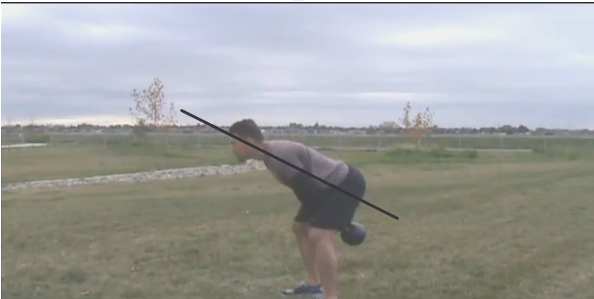
There should be a totally, completely straight line from your hip to your shoulder during the Swing – like this:
Don’t be afraid to let your body come forward; just don’t confuse a straight back with a flat back. In my experience, when people think ’straight’, they think their body has to be straight up and down.
The fix:
Stand in front of a heavy bag. Do a Sumo Deadlift and ‘punch’ the bag with your butt as you decend into the movement and the kettlebell gets closer to the floor. You should feel the hamstrings load up during the movement and should feel nothing in the lower back. Once you’ve ‘grooved’ this movement, do a few Swings – and try to get the same feeling and patterning in the lower body.
2. Swinging the ‘bell too low to the ground
Another common mistake during the Swing is when you ‘hike pass’ the weight back, you end up with the weight too close to the ground. This is a sure-fire way to cause lower back pain with the Kettlebell Swing.
The fix:
The kettlebell should be close and tight to the body as you do your Swings – imagine you’re hike passing a football. Another visual that helps is to try and get the bottom of the ‘bell to face the wall behind you.
So there you have two common causes of lower back pain during the Kettlebell Swing – and two drills to perfect your form. Keep training hard!
Additional Kettlebell Swing Resources:
Lifetime Kettlebell Fitness – Learn how to do kettlebell swings (and the other KB basics) from the “ground up” – great beginner’s resource