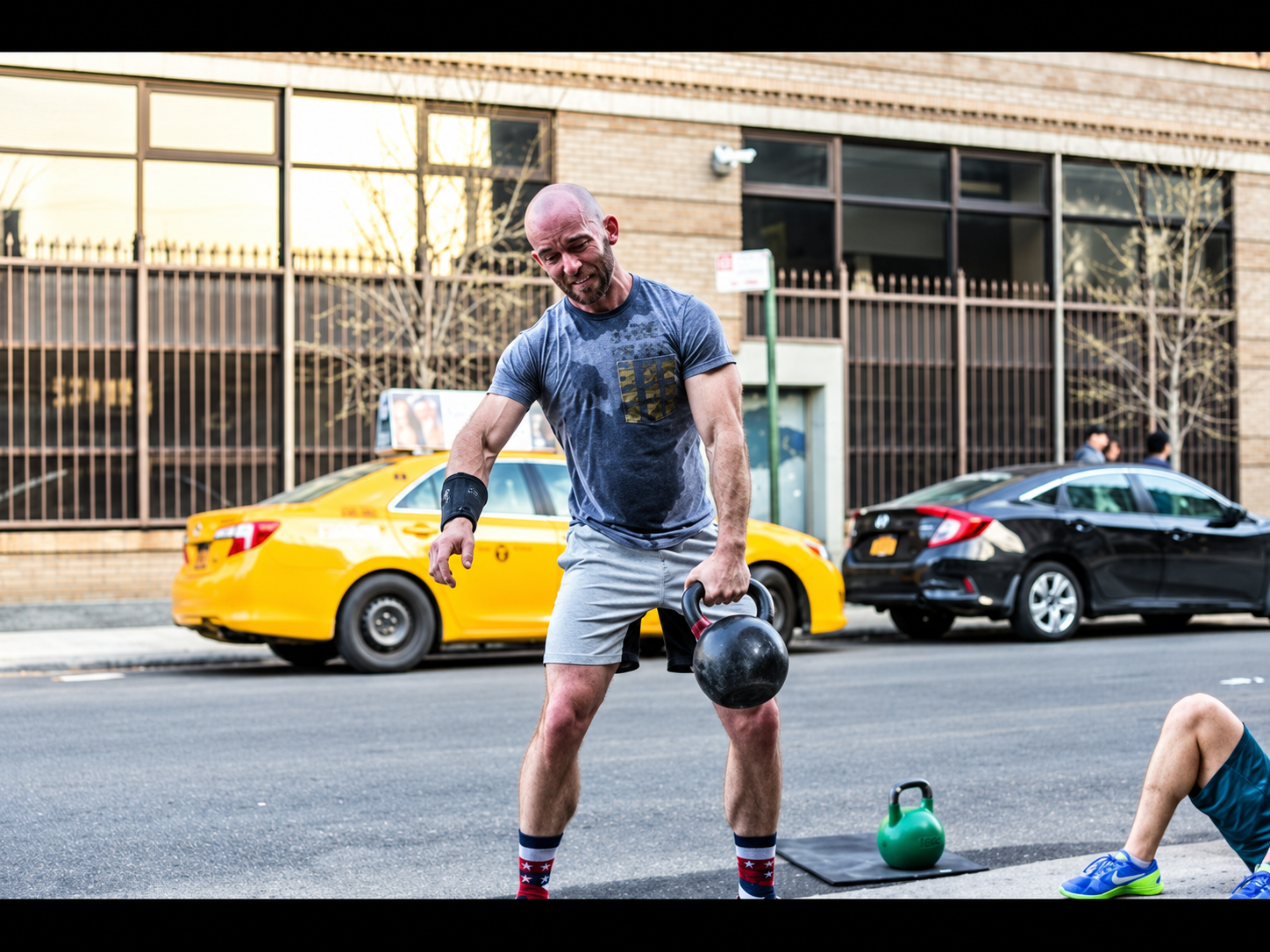
The kettlebell snatch is one of the best total-body exercises for power, conditioning, grip, and more.
But it’s also one of the most technical kettlebell movements – and if your technique is off, you’ll know it pretty quickly when that bell starts banging into your wrist.
Here are 3 simple hacks that can instantly improve your snatch:
1 – Aggressively Spear Your Hand Through at the Top
Don’t let the kettlebell come around and crash onto your wrist.
As the bell comes around the top, instead, aggressively bring your hand TO the kettlebell and punch through.
2 – Keep the Arc Close to Your Body
You don’t want the kettlebell making a huge looping arc away from you.
Keep it close to your body throughout the movement.
One great way to practice this is from the top down. Start in the lockout position and keep the bell close as you guide it back into the backswing.
3 – No Corkscrew
In HardStyle kettlebell training, we do NOT corkscrew the kettlebell on the way up or the way down.
The bell flips straight over the hand and wrist.
The snatch takes time to master, but these three adjustments can make a HUGE difference.
Can you sit down on the floor and stand back up without using your hands?
I ask because this is a 10-second test that just might predict how long you’ll live!
You see, a big study came out in the European Journal of Preventive Cardiology. Researchers took 4,282 adults between 46 and 75 years old and had them do exactly that: sit down on the floor and get back up.
They scored each person from 0 to 10. You lose a point every time you use a hand, a knee, or something to hold onto, and half a point if you’re wobbly.
Then they followed those people for about 12 years.
Here’s what they found.
Of the people who scored a perfect 10, only 3.7% died.
Of the people who scored 0 to 4, 42% died.
That’s not a small difference. That’s huge.
Now, it’s an observational study, so it doesn’t prove the test itself keeps you alive. But it tells you a lot about what’s going on under the hood.
Getting up and down off the floor takes strength. It takes balance. It takes coordination.
All of that matters.
But I’d argue one of the biggest pieces, and the one almost nobody trains, is hip mobility.
Think about it. To get down to the floor without your hands, your hips have to fold, rotate, and open up. If they’re locked up from years of sitting at a desk and in the car, you’re reaching for the floor with your hands before you even get started.
So here’s your homework:
Take the test. Barefoot, on a mat or carpet.
Be honest with your score.
Pay attention to how it FEELS. Even if you can do it, do your hips feel tight, stiff, or like they’re fighting you on the way down?
If you can’t do it, or if you can but your hips are what’s holding you back, I want you to check out the 8-Minute Hip Fix.
It’s a short daily routine built to open up exactly the range of motion you need to get up and down off the ground with control, and keep doing it for the rest of your life.
Take the test today. Then retest in a few weeks and see what changes.
— Forest
PS – Strength, total body strength, core strength, coordination, and balance are all also parts of this test. Don’t get me wrong, if you’re training with my kettlebell programs, which hopefully you are if you’re on this email newsletter, that’s going to take care of a lot of that. However, if your hips are very tight, kettlebells will address that to some degree, but you’d probably need more specific work on it. That’s why I would also recommend the 8-Minute Hip Fix if you try this test and your hips are also tight -> 8-Minute Hip Fix
PPS – If you have hip, knee, or spine arthritis or another joint issue, skip the test and talk to your doctor first.
One of the things I like about having specific fitness goals is that they give you something to work toward.
For example, in our upcoming Winter Warrior Challenge, we’re training toward these kettlebell weight standards:
Women:
Level 1: 12 kg (26 lbs)
Level 2: 16 kg (35 lbs)
Level 3: 20 kg (44 lbs)
Men:
Level 1: 20 kg (44 lbs)
Level 2: 24 kg (53 lbs)
Level 3: 28 kg (62 lbs)
We’ll be using these weights for two of our five challenge events:
1. 100 One-Arm Kettlebell Swings in 5 Minutes
10 swings every 30 seconds, alternating hands, for five minutes.
2. Maximum Single-Rep Kettlebell Press
Clean the kettlebell from the floor and perform one strict overhead press with one arm.
Now, a couple of important things here.
1 – DON’T start with these weights if you’re not ready for them!
For some of you, these standards might sound extremely challenging. For others, they might sound pretty doable.
That’s because we’re all starting at different levels.
Some of you have been training with kettlebells for years. Others are relatively new. Some are working around old injuries or limitations.
And that’s perfectly fine.
But I do think these are reasonable, achievable strength and conditioning goals for many healthy men and women in their 40s, 50s, and 60s, given enough time, consistent training, and appropriate progression.
You might not reach Level 3 in 16 weeks. You might not even reach Level 1 yet.
2 – That’s not the point. The point is to have something to work toward.
If you’re swinging a 12 kg kettlebell today and working toward 16 kg, that’s progress.
If you’re pressing 16 kg and working toward 20 kg, that’s progress too.
We want to build strength, improve conditioning, and maintain our physical capabilities as we get older.
And having specific, measurable goals is one of the best ways to make sure we’re actually moving in that direction.
So here’s my question: What kettlebell weight are you currently using for your swings and presses, and what weight would you like to work toward over the next 16 weeks?
Reply and let me know!
— Forest
PS – If you want to sign up for the 16-week transformation program, we officially start today – reply directly to this post and I’ll shoot you the details.
PS — If you already know you want to do the full 16 weeks, don’t buy Phase 1 separately.
The complete 16-Week KB Transformation is $99 includes all four phases, all the bonuses that come with each challenge, app delivery, and the full progression leading into the Winter Warrior Challenge.
Today I’ve got a 20-minute extreme kettlebell conditioning workout for you.
It’s a sample from Phase 1 of the 16-week transformation we’re about to get started. Check out the workout below, and if you want to sign up for the whole thing, look at the bottom of this email for the details.
(Already know you’re in? Just hit REPLY and say “I’M IN.”)
This workout comes from our upcoming Extreme KB Cardio Conditioning Challenge, 2026 Edition. It’s a 28-day program, but it’s also Phase 1 of the full 16-week transformation.
Phase 1 is all about conditioning. Think about it this way: we’re building the engine, burning calories, and laying the foundation.
Plus, you’re going to be so active with kettlebells, bodyweight training, walking, rucking, sprinting or cardio on your off days, and mobility work, that you might even lose weight without changing your diet!
After that, we move into:
Phase 2: Strength. You’ll get stronger with heavier kettlebell presses, pulls, and hinges.
Phase 3: Power & Endurance. We take that strength and turn it into explosive power and muscular endurance with kettlebells, bodyweight, and more.
Phase 4: Winter Warrior Prep. We put everything together and get ready for the challenge.
(Want all four phases for one price? Reply “I’M IN”)
We’re working toward the Winter Warrior Challenge at the end of January:
100 kettlebell swings in 5 minutes
Max single-rep kettlebell press
Max unbroken push-ups
Max unbroken pull-ups, chin-ups, or chin-up holds
Max burpees in 60 seconds
All the training over these 16 weeks ramps you toward those tests. You’ll lose fat, gain lean muscle, feel great, perform well, and get more mobile, so you can hit these goals 16 weeks from now.
(The 16-week deal closes when Phase 1 starts. Reply “I’M IN” to lock it in.)
OK, all that said, here’s one sample workout from Week 1:
#
25-min “Extreme KB Conditioning” workout
MAIN CIRCUIT: Do as many rounds of the sequence below as you can in 10 minutes:
Imagine 16 weeks of this, building on itself every phase.
Want in on the whole thing?
Quick confession. I said the 16-week deal was a one-time thing. But you guys keep replying asking about it, so I’m keeping it open for a short time longer.
Once Phase 1 kicks off, it’s gone. Not because I’m being dramatic, but because the program will have started, and this is the only way to get in on all 16 weeks from day one.
Here’s the deal: the entire 16-week Winter Warrior training series for $99. One payment, no recurring billing.
You’ll get:
All 16 weeks of progressive workouts delivered through our training app
All four 28-day challenges as they’re released
All the bonuses included with each challenge, from mobility and recovery to nutrition resources, extra workouts, and more
The complete progression leading up to the Winter Warrior Challenge
For comparison, each challenge on its own is $37. Do all four and that’s $148. The bundle saves you $49, and if you think you’ll do more than two challenges, it pays for itself.
Just REPLY to this email and say “I’M IN,” and I’ll send you the link to get signed up.
Can you actually lose weight through exercise alone – WITHOUT changing your diet?
Most people assume the answer is no.
You’ve probably heard the saying that you can’t out-exercise a bad diet.
And while there’s some truth to that, the research is actually a little more interesting.
A review published in Diabetes Spectrum examined the role of exercise in weight loss and weight maintenance.
One of the studies it discussed followed overweight adults who exercised five days per week, burning approximately 400–600 calories per session.
Among participants who completed the 10-month program, average weight loss was approximately 8.6–11.5 pounds.
And they weren’t following a prescribed calorie-restriction diet.
Another study found that people who exercised about 60 minutes per day lost a meaningful amount of weight over three months without prescribed dietary restriction.
Now, there’s a catch.
The amount of exercise matters.
A couple of 20-minute workouts per week probably aren’t going to produce dramatic weight loss on their own.
But what happens when you significantly increase your total weekly activity?
I’m talking regular, serious kettlebell workouts, plus walking/running/conditioning, plus recovery/mobility work, and more.
That’s what got me thinking.
What if we took a group of people over 40 and had them focus on MOVING MORE for 28 days, without deliberately changing their diets?
Could they lose a pound or two a week?
Could they improve their waist measurements?
Could they get stronger and feel better along the way?
The research suggests exercise-only weight loss is possible, although individual results vary considerably.
And I think it would be pretty interesting to put that idea to the test.
More on that tomorrow.
– Forest
P.S. Here is a link to the review published in Diabetes Spectrum – https://pmc.ncbi.nlm.nih.gov/articles/PMC5556592
You might not believe me, but I think we can keep training hard — even as we age!
We just have to be a little smarter about it.
One thing that becomes especially important as we get older is power.
Strength is the ability to move a load. Power is the ability to move that load quickly.
Maintaining power as we age matters because it affects reflexes, balance, athleticism, and our ability to react quickly.
That’s one reason I love kettlebell swings for the 50+ crowd.
Unlike slow, controlled strength exercises, swings are explosive. Every rep teaches your glutes, hamstrings, and the rest of your body to generate force quickly.
Of course, that doesn’t mean we should train exactly like we did at 20!
We still need to pay attention to things like work-to-rest ratios, total workout volume, exercise selection, proper form, mobility, and recovery.
Beginner: 12–16 kg (men), 8–12 kg (women) Intermediate: 20–24 kg (men), 12–16 kg (women) Advanced: 24–32 kg (men), 16–20 kg (women)
Choose the swing variation that feels best for your back and hips.
PART 2 — STRENGTH & CONDITIONING
3 rounds
Split squats — :30/side OR Goblet squats — :60
Recommended weights:
Beginner: 8–12 kg Intermediate: 12–20 kg Advanced: 20–28 kg
If lunges bother your knees, goblet squats are a great option.
Burpees
Modify as needed: box/bench burpee, step-back burpee, or wall burpee.
PART 3 — CORE & STABILITY
3 rounds
Rack march/carry — :30/side
Use approximately one size heavier than your pressing weight.
The weight should be challenging but stable — no leaning or twisting.
Supported side plank — :30/side
Start from a table position with the bottom knee down and top leg long.
This variation is joint-friendly while still challenging the obliques and hips.
#
If you want to learn how to do kettlebell swings and the other essential kettlebell exercises safely and effectively, check out Lifetime Kettlebell Evolution.
It’s built specifically for men and women in their 50s and beyond who want to gain strength, prevent injury, and build functional fitness without beating up their bodies.
You’ll get short, 20–30 minute kettlebell workouts, joint-friendly warm-ups, strength-based exercise progressions, built-in modifications, and a complete system you can follow at home with minimal equipment.
Plus, you’ll get 3 bonus programs FREE:
• Lifetime Kettlebell Fitness 2.0 (Over 50 Kettlebell Revolution) — my best-selling over-50 kettlebell training system.
• Ageless Warrior Kettlebell Challenge — an additional 28-day program to keep your progress rolling.
• Kettlebell Hacks Workshop Series — 12 training videos covering my best tips, drills, and progressions for mastering swings, squats, cleans, snatches, Turkish get-ups, presses, and more.
You get the complete package when you grab Lifetime Kettlebell Evolution while it’s on sale this week:
This workout is designed to help you build strength, boost your energy, stay healthy and capable for the long haul — and yes, look pretty darn good with your shirt off too 😉
All you need is one kettlebell and 18 minutes.
Do 3 rounds: 30 seconds work / 15 seconds rest Rest 60 seconds between rounds.
TIER 1 — BEGINNER
* Kettlebell “Goat Bag” Swing → 2-Hand KB Swing Suggested: 16kg women / 24kg men * Plank Step-Out * Bodyweight Squats * Kettlebell Figure 8 to Hold Suggested: 8–12kg women / 16–20kg men * Step-Back Squat Thrust
TIER 2 — INTERMEDIATE / ADVANCED
* 2-Hand KB Swing → 1-Arm KB Swing Suggested: 8–12kg women / 16–20kg men * Plank Jacks * KB Goblet Squats * Kettlebell Figure 8 to Hold Suggested: 8–12kg women / 16–20kg men * Squat Thrust → Burpee
This workout is brought to you by Lifetime Kettlebell Evolution.
If you are looking to test your strength, kettlebell form, mental capacity, and lungs… I dare you to take this test.
It’s a sample from the 300 Kettlebell Challenge 2.0 – where you’ll do a strength (and overall fitness) test at the beginning of the 28-day program – a special 300-rep kettlebell workout.
It gives you a great, measurable starting point. It also helps you set goals for the end.
Then, for the main program, you do workouts that will help you do better at that original “benchmark” training session – and at the same time, help you with things like:
– Losing fat – Gaining lean muscle – Strengthening your core – Getting more flexible – Improving overall performance
We even do a different 300–rep kettlebell workout every week just for fun, and so that you can see your fitness improving along the way – like this:
Do the sequence of exercises below as fast as possible. Make note of weights used. Time yourself. We’ll repeat this workout again in week 4, so be sure to record your performance so that you can see how you improve!