*If you want a complete program designed to help you make up to 55% (or more) improvement in your mobility over the next 28-days, check out the 28-day Kettlebell Mobility Challenge starting Monday, September 26th 2022:
The kettlebell arm bar is one of the first exercises I recommend for people looking to improve their shoulder mobility and/or stability.
Some of the benefits of this exercise are:
– improved rib cage mobility – improved thoracic spine mobility – loosened up pecs – loosened up the fascial line between the pecs and the opposite hip – healthy shoulders!
HOW TO DO IT
Start lying on the ground, with the KB at your side, at shoulder level, in what we call the “cradle” position. (Looks like you at the start of a Turkish get up)
Now pull the KB to the body, roll to the back, and extend the working arm to lock out. (Be sure to pack the shoulder back and down for stability!)
Now, take the same leg as your working arm, and drive it over the top of your body. You’re going to drive that hip towards the ground, as well as bringing the working shoulder towards the ground.
Breath in and then exhale, driving the hip and shoulder towards the ground a little more each time. Do this three to five times progressively.
Be sure to watch the video that shows how to do this exercise too.
Incorporate the movement into your routine and see the change you can create!
– Forest Vance Master of Science, Human Movement Certified Kettlebell Instructor Certified Corrective Exercise Specialist KettlebellBasics.net
PS – If you want a complete program designed to help you make up to 55% (or more) improvement in your mobility over the next 28-days, check out the 28-day Kettlebell Mobility Challenge starting Monday, September 26th 2022:
Suspension trainers are a versatile and portable piece of equipment that can be used for a variety of exercises. They can be used for bodyweight exercises, functional training, and even rehabilitative exercises.
In this article, I will share 3 unique suspension trainer exercises that you’ve likely never tried before. These exercises will challenge your muscles and help you build strength and endurance!
*If you’re looking for a way to mix up your suspension trainer workouts, try out the three exercises described in this article. These exercises are unique and will help you achieve your fitness goals. If you’re looking for more information on suspension training, check out the Suspension Revolution 2.0 course at the link below. This course includes 27 full workouts and 191 different exercises:
*If you missed the 20-Minute Total Body KB/BW/Suspension Workout I posted yesterday, be sure to check that out as well at the link below – you’ll blend the moves you learned it today’s article with kettlebells for a killer total-body training session:
Unique Suspension Trainer Exercise You’ve Never Tried (But Should) #1: The Atomic Push Up
The atomic push up is a challenging exercise that works the chest, shoulders, and triceps. Here’s how to do it:
Start in a push up position with your feet in the suspension trainer handles and your hands on the ground
Lower your body down towards the ground, keeping your core engaged
Push yourself back up to the starting position, and at the same time tuck your knees into your chest and lift your hips
Repeat for reps.
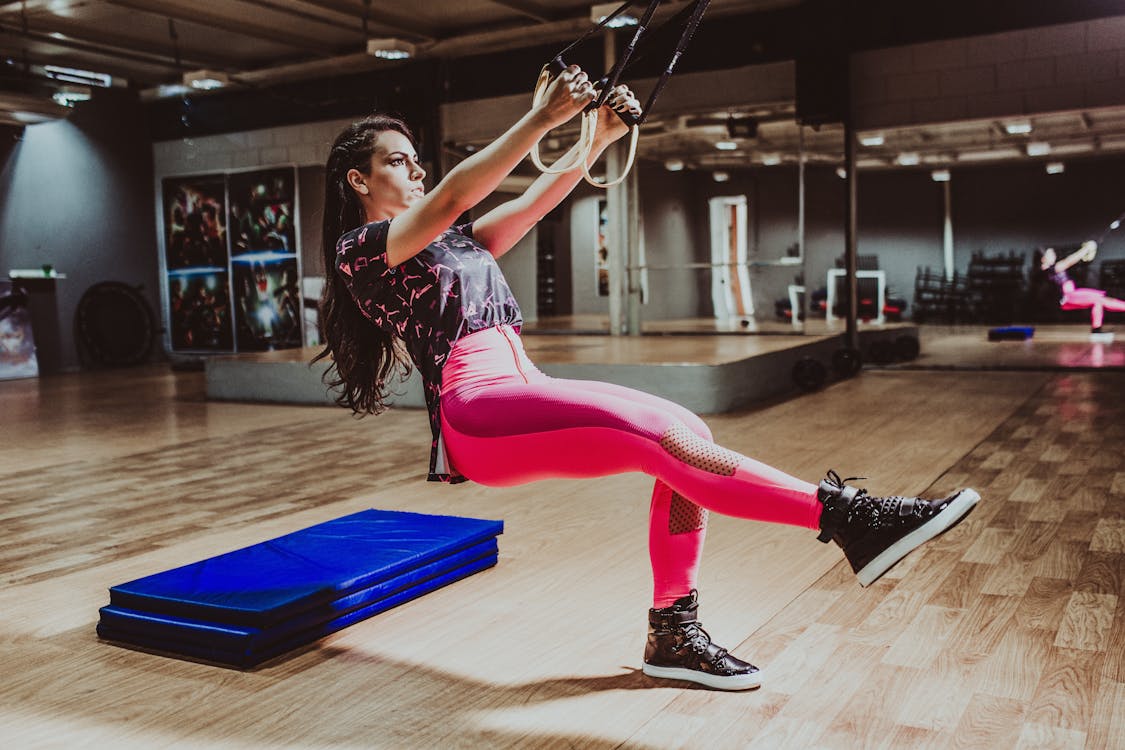
Unique Suspension Trainer Exercise You’ve Never Tried (But Should) #2: The Single Leg Squat
The suspension trainer single leg squat is a great exercise for building strength and stability in the lower body. This exercise can be done with a variety of different widths and angles to target different muscles groups:
To perform the exercise, start by placing the suspension trainer in a door frame or other sturdy structure.
Then, place one foot in the foot stirrup and the other foot on the floor.
Squat down until your thigh is parallel to the floor, then return to the starting position.
Repeat for the desired number of reps.
Unique Suspension Trainer Exercise You’ve Never Tried (But Should) #3: The Suspension Trainer Burpee
The suspension trainer burpee is a challenging full-body exercise that combines the muscle-building benefits of a burpee with the core-strengthening benefits of a suspension trainer. This exercise is not for the faint of heart – it is challenging and will push your body to its limits. But if you’re looking for a way to take your fitness to the next level, the suspension trainer burpee is a great option.
Here’s how to do this exercise:
Start in a standing position facing away from your suspension trainer with in the foot stirrup and the other foot on the floor
Put your hands on the ground and jump your feet back so that you land in a plank-type position with one foot still in the stirrup and the other foot suspended in the air
Do a push up, then jump your feet forward and return to starting position
Repeat for reps.
#
If you’re looking for a way to mix up your suspension trainer workouts, try out the three exercises described in this article. These exercises are unique and will help you achieve your fitness goals. If you’re looking for more information on suspension training, check out the Suspension Revolution 2.0 course at the link below. This course includes 27 full workouts and 191 different exercises.
Forest Vance Master of Science, Human Movement Kettlebell Expert Over 40 Training Specalist KettlebellBasics.net
PS – If you missed the 20-Minute Total Body KB/BW/Suspension Workout I posted yesterday, be sure to check that out as well – you’ll blend the moves you learned it today’s article with kettlebells for a killer total-body training session!
If someone wants a single piece of equipment that will work their whole body in 20-30 minutes, giving them a strength, cardio, core, and flexibility workout all at the same time…
Suspension trainers are versatile and portable workout tools that can be used for a wide variety of exercises. They can be used for beginner, intermediate, and advanced variations of bodyweight exercises like push ups, bodyweight rows, squats, lunges, and more. They also provide an instability that promotes functional movement and core stability, which is an amazing addition and compliment to your kettlebell training.
Suspension trainers can be easily set up at home, at the park, at the gym, or anywhere else you have access to a solid anchoring point. All you need is something to anchor the straps to, like a tree, a pull-up bar, or a goalpost.
If you are looking for a suspension trainer program that is versatile and can give you a great workout, I recommend the Suspension Revolution 2.0. This course provides 27 full suspension training workouts as well as 191 different suspension exercises. The course is a great compliment to the kettlebell training you are already doing!
Check out this 20 Minute Total Body KB/BW/Suspension Workout, inspired by Suspension Revolution 2.0:
#
20-Minute Total Body KB/BW/Suspension Workout
Pair 1 – 3 rounds, as little rest as possible:
single arm KB swing – 7 ea arm
suspension trainer atomic push up – 8
(rest 60 seconds)
Pair 2 – 3 rounds, as little rest as possible:
bottoms – up KB press – 6 ea side
suspension trainer single leg squat – 8 ea side
(rest 60 seconds)
To finish – 4 rounds, as fast as little rest as possible:
suspension trainer burpee w push up – 6 (switch foot in cradle ea rep)
KB squat clean – 8
30 jumping jacks
#
Thanks for working out! Now that you’re all warmed up, go ahead and check out the full course at the link below. With Suspension Revolution 2.0, you’ll get access to all the information and resources you need to succeed. Thanks again, and cheers to your success!
It all depends on your definition of “heavy kettlebells” (or just heavy weights in general).
If you’re talking about the training, exercises, and lifestyle that strongmen or powerlifters do, then no, it’s terrible for the body.
Many of these athletes are literally eating as much as they can to get as big as possible and to lift as much weight as possible. They are doing whatever it takes to be the best. As a result, they are putting themselves at risk for a multitude of health issues, like strain on the cardiovascular system, and destroying the joints.
However, “heavy lifting” is a subjective term.
Lifting weights in general, with reasonably heavy weights and good form – like I teach in my KB / BW Hybrid Training 2.0 course! – can be highly beneficial to the body. It contributes to increased muscle mass (which has been shown to have a positive impact on mortality rates) as well as increasing bone density (which is huge in counteracting the effects of aging and arthritis).
To learn how to lift kettlebells properly and with good form, so that you can get all of the benefits and none of the risks, check out KB / BW Hybrid Training 2.0 at the link below:
-Forest Vance Master of Science, Human Movement SFG-Certified Kettlebell Instructor Owner, FVT Personal Training (gym in Sacramento, CA) Owner, KettlebellBasics.net (online / worldwide)
You might only have a few kettlebells to use. Or maybe you want to keep the weights lighter to be easier on your body. But you still want to get stronger! How can you do this? People usually think they need to add more weight to the kettlebell to increase strength and power. But the good news is that there are other ways to do this without adding more weight!
If you want to get stronger, you need to gradually increase stress on your body over time – this is called progressive overload. There are lots of ways to do this, not just by adding weight.
We use this concept in my new course, which is a kettlebell and bodyweight hybrid strength training course – it’s coming out this week, so stay tuned!
In the meantime, here are three ways to get stronger without increasing your kettlebell weight:
1 – Increase your reps
If you can perform more reps with the same weight, you’ll be working your muscles harder and increasing your strength.
2 – Add more sets to your routine
Instead of doing the same number of sets with a heavier weight, try adding one or two more sets with your current weight. This will help you build muscle and get stronger without having to go up in kettlebell weight.
3 – Do different and/or more challenging exercises
Another way to change things up is to focus on different and/or more challenging exercises. If you’re always doing swings, try adding in some cleans or snatches. Or if you’re used to doing goblet squats, try switching to single-leg squats. By strategically changing and progressing your exercises, you will force your body to adapt, and you can get stronger over time without having to add weight.
So there you have it – three ways to get stronger without having to go up in kettlebell weight. Give them a try and see how they work for you!
-Forest Vance Master of Science, Human Movement Kettlebell Expert Over 40 Training Specialist KettlebellBasics.net
PS – Don’t forget – if you like the idea of getting stronger without having to go up in kettlebell weight, stay tuned! I have a NEW version of my Kettlebell / Bodyweight Hybrid Training course coming out later this week!
The “American” kettlebell swing has become a popular exercise among Crossfitters and other fitness enthusiasts. However, this version of the swing is actually quite different from the traditional Russian version, and it can actually be quite dangerous.
Here are three reasons to avoid the American kettlebell swing:
1 – The American kettlebell swing involves swinging the kettlebell all the way overhead, which can place unnecessary stress on the shoulders.
2 – The American kettlebell swing also tends to be quite jerky and uncontrolled, which can lead to injuries.
3 – The American kettlebell swing may target the arms and shoulders more than the legs and hips, and this can actually detract from the effectiveness of the exercise. The point of kettlebell swings is to work specific muscle groups, and by focusing on the wrong areas, you won’t get the full benefits, and you may even be more likely to get injured.
The Russian swing is the way to go if you want to avoid American kettlebell swings. It’s more controlled, which makes it safer. It’s easier on the shoulders. And you’ll target the intended muscle groups better in the legs and hips.
Check out the video tutorials in the 28-day Drop-a-Size KB Challenge (we’re extending registration by one extra day!) for more instruction on how to perform the Russian swing correctly:
The American kettlebell swing is a movement that should be avoided. I hope this article has helped to educate you on the reasons why. Please to the Russian version of the kettlebell swing instead, and have a great workout today!
– Forest Vance Master of Science, Human Movement Kettlebell Expert Over 40 Training Specialist KettlebellBasics.net
The kettlebell figure 8 to hold is a great exercise for the core, the grip, and the whole body! However, a lot of people get it wrong. Here are three tips to help you improve:
1 – Engage Your Core
Keep your core muscles tight, and don’t let your body twist as you do the move.
2 – Pass the Kettlebell Between the Legs
Sometimes people pass the kettlebell outside the legs to start the move. Don’t do this. Instead, pass the kettlebell between the knees, around the back of the body, and back up to the hold position.
3 – Pass the Kettlebell Off Correctly
When you pass the kettlebell from one hand to the other, you want one hand on one side of the horn of the KB, and the other hand on the other side of the KB. This makes for a much smoother transition.
There you have three tips to help you improve your kettlebell figure 8 to hold.
-Forest Vance Master of Science, Human Movement SFG-Certified Kettlebell Instructor Owner, FVT Personal Training (gym in Sacramento, CA) Owner, KettlebellBasics.net (online / worldwide)
Today’s 5-minute isometric workout is something you can do any time, any place! It’s a method used by old-time strongmen as a big part of their training programs, and it’s effective for building strength and muscle. Plus, there’s no equipment required.
It’s a great addition to your kettlebell training, too!
Click the link below to learn more, and to get the full 8 week plan:
PS – It’s no secret that isometric exercises are having a bit of a moment right now. Celebrities like Angelina Jolie, Uma Thurman, and Penelope Cruz have all been spotted using them, while athletes and trainers all around the world have been turning to them for greater strength and health.
It all started with a Buddhist monk in the 12th century, who developed a system of twelve basic isometric exercises. These exercises were later adopted by other martial arts, such as Kung Fu, Tai Chi, and Ki Gong.
These once forgotten isometric exercises are the perfect compliment to your kettlebell training.
Click the link below to learn more, and to get the full 8 week plan:
Around this time last year, I started getting some strange things going on.
I was feeling things like:
Difficulties with concentration and memory
Fatigue
Irritability
Loss of strength in my kettlebell workouts
Overall decreased sense of well-being
I realized that, through a combination of dieting over a few months to get as lean as possible for my 40th birthday, and the fact that I was actually turning 40 lol, it was possible that I had a drop in my testosterone levels.
I got tested, and sure enough, I was below acceptable range.
Before running out and hopping on testosterone replacement therapy like it seems like so many guys are these days, I decided to look into ways I could boost myself back up normally.
I applied the three things listed below, and within a few months, I had brought my baseline up by over 200 points!
I want to do this naturally as long as possible, and I think you might want to as well, so here are 5 ways you can try to boost natural testosterone levels for better kettlebell workouts (and life!):
#
5 Ways To Naturally Boost Testosterone For Better Kettlebell Workouts
1 – Train Regularly / Lift Weights
There are a few different ways that exercise can help boost testosterone. First, it can help increase your body’s production of the hormone. Additionally, exercise can help reduce the amount of the hormone that is broken down by your body. And finally, exercise can help increase your testosterone levels by increasing your levels of other hormones that promote testosterone production.
2 – Eat Healthy Fats
One of the most important things you can do to keep your testosterone levels up is to eat healthy fats. Healthy fats help to produce testosterone and other hormones in the body.
Some good sources of healthy fats include olive oil, avocados, nuts, and seeds. You should aim to get a good mix of these healthy fats in your diet.
3 – Minimize Stress
When you’re stressed, your body releases a hormone called cortisol. This hormone can cause a variety of problems, including decreased testosterone production. So if you’re looking for ways to naturally boost testosterone, one of the best things you can do is to reduce stress in your life.
4 – Get Enough Sleep
We all know that getting a good night’s sleep is important for our overall health. But did you know that it’s also essential for keeping your testosterone levels up? That’s right – studies have shown that men who don’t get enough sleep have lower testosterone levels than those who do. So if you’re looking for a natural way to boost your testosterone, make sure you’re getting plenty of rest!
5 – Supplement with Ashwagandha, Zinc, and Vitamin D
Ashwagandha increases exercise performance, strength, and fat loss while boosting testosterone levels. One small study in 57 men found that taking 600 mg of ashwagandha extract increased testosterone levels by nearly 15% after 8 weeks compared to a placebo.
Zinc and vitamin D are both essential for testosterone production, and can results in low levels of testosterone if deficient.
A great (and tasty!) way to get these herbs and vitamins is with the supplement on the page linked below:
If you implement these 5 methods, you could see a significant increase in your testosterone levels, which will lead to better kettlebell workouts (and a better quality of life!)