You can use this as a standalone session or as a metabolic finisher after a strength-based workout. Either way, it’ll push your conditioning to the next level.
Complete 3 (beginner) to 5 (advanced) rounds as fast as possible:
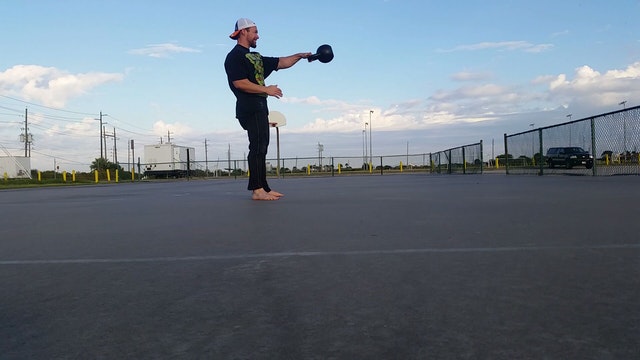
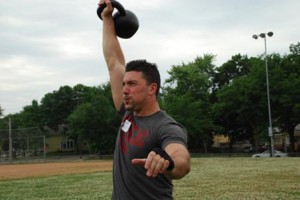
2 windmills – Beginners can use the “bottom hand” windmill variation; intermediate/advanced can do the standard version (fully broken down in my instructional video series included with Ultimate Kettlebell Challenge Workouts 2025).
4 rack squats
6 one-arm swings (beginner) / snatches (intermediate/advanced) (Perform all movements on both the right and left sides, then:)
With the weather warming up here in KC and spring right around the corner, I’ve been taking more of my KB workouts outside. There’s nothing like training outdoors—fresh air, sunlight, and a single kettlebell to get your strength, cardio, and core work all in one session.
— 33 of my classic kettlebell workouts – battle-tested, time-efficient, and brutally effective. — Full recordings of my Kettlebell Basics Workshop – dial in your form and avoid the most common KB mistakes. — The Ultimate Kettlebell Guidebook – master technique, improve performance, and train smarter.
If you’ve been following me for a while, this is a killer deal and a great entry point into my world of kettlebell training.
Check out the sample workout below, then grab the deal before it’s gone → Get it here
#
Try the 20-Minute “KB/BW Beat Down” Workout
This one’s a total-body challenge—fast, intense, and effective:
Pair #1: KB Swings & Push-Ups
KB Swings – 12 reps
Push-Ups – 12 reps
Repeat for 5 minutes, resting as little as possible.
It was my 7th-grade Presidential Physical Fitness Test.
I hopped up on the bar, pulled with all my might… and couldn’t do a single one.
My PE teacher took pity on me and gave me credit for one—even though I didn’t earn it 🙂
Honestly, I don’t have the natural build for pull-ups. But over the years, I’ve used methods like those in Operation Pull-Up: 28-Day Challenge(new and updated for 2025) to go from zero to 13 strict pull-ups in a single set.
Now, I want to help you do the same.
This weekend, you can get the 28-Day Challenge for free when you pick up a copy of Warrior Flow Isometrics 2.0:
If you’re starting from scratch, this program will build the strength and mechanics to get your first pull-up.
Here’s an example from the beginner track:
Track 1: Beginner (0 Pull-Ups)
Goal: Build foundational pulling strength and proper mechanics.
Day 1:
Hollow hold on the floor: 3 x 25 seconds
Ring/TRX rows: 3 x 12–14 reps
Partner/self-assisted pull-ups: 4 x 5 (use less assistance than Week 1)
Day 2:
Hollow hold on the bar: 3 x 20 seconds
Active negatives: 4 x 3 reps (5–8 seconds per rep)
Flexed-arm hangs: 3 x 15–18 seconds
Day 3:
Self-assisted pull-ups: 4 x 5
Hollow hold on the bar: 3 x 15–20 seconds
Ring/TRX rows: 4 x 10
Already knocking out pull-ups? Here’s a sample from the advanced track:
Track 4: Advanced (9–12 Pull-Ups)
Goal: Progress to 13–15 pull-ups with added resistance and endurance ladders.
Day 1:
Pull-up ladders: 9, 8, 7, 7, 6 (total: 37 reps)
Hollow hold on the bar: 3 x 25 seconds
Day 2:
Pull-up ladders: 9, 8, 7, 7, 7 (total: 38 reps)
Flexed-arm hangs: 3 x 18 seconds
Day 3:
Weighted pull-ups: 4 x 3 (light-moderate weight)
Hollow hold on the bar: 3 x 25 seconds
Active negatives: 3 x 5 reps
To make this program even better, my trainer Alex—who is great at pull-ups—helped with the videos for the advanced workouts, so you’ll get clear demonstrations.
No matter where you’re starting, this 28-Day Challenge will get you moving, and you can repeat it until you hit 20 pull-ups.
Learn more and get it here while it’s free this weekend with Warrior Flow Isometrics 2.0:
Do you have the latest and improved version of my Operation Pull-Up Blueprint?
This is your ultimate guide to mastering pull-ups, with step-by-step progressions designed to take you from zero to 20 reps. You can get it free when you order a copy of my Warrior Flow Isometrics 2.0 program this weekend.
What’s New in the Operation Pull-Up Blueprint?
The updated version is now structured as a 28-day challenge. The best part? We’ve created six different training tracks, so you can start at the level that matches your current ability.
For example, here’s week 2 of the Level 2 track—designed for someone who can currently do 1 to 4 pull-ups:
End-of-challenge goal: Progress to 5–6 strict pull-ups by increasing volume and refining technique.
Week 2 Training Plan (Level 2)
Day 1:
Hollow hold on bar – 3 x 20 seconds
Pull-up ladders – 1, 1, 2, 1, 1 (total: 6 reps)
Ring/TRX rows – 3 x 10
Day 2:
Pull-up ladders – 2, 1, 2, 1, 1 (total: 7 reps)
Active negatives – 3 x 4 reps (6–8 seconds per rep)
Hollow hold on bar – 3 x 20 seconds
Day 3:
Pull-up ladders – 2, 2, 1, 1, 1 (total: 8 reps)
Flexed-arm hangs – 3 x 18 seconds
Whether you’re working toward your first pull-up or already knocking out 15+ and aiming for 20, we’ve got a proven plan to get you there.
And remember—this entire Operation Pull-Up Blueprint is free when you grab Warrior Flow Isometrics 2.0 this weekend only.
Centuries ago, warriors trained using static holds, breath control, and focused tension to build raw strength, endurance, and resilience.
They didn’t have fancy equipment. No machines. No high-impact pounding on their joints. Just bodyweight, discipline, and time-tested methods to prepare for battle.
Fast forward to today—we’re bringing that same approach into the modern world with Warrior Flow Isometrics 2.0.
This is your chance to get stronger, move better, and stay injury-free in just 20-30 minutes, 3-4 times per week.
No equipment. No stress on the joints. Just results.
This 20-minute session blends yoga-based holds with controlled movement to build strength, improve mobility, and boost endurance.
Instructions:
Hold each position for 45 seconds
Rest for 15 seconds between movements
Complete 3 rounds
1 – Wall Chair Hold – Press your back flat against a wall and lower into a squat with knees at 90 degrees. Engage your quads, glutes, and core—don’t let your lower back arch. Press your arms into the wall for an extra challenge or extend them overhead. Hold strong, breathing deeply.
2 – Lizard Lunge Hold (Alternating Sides from High Plank) – Start in high plank with hands under shoulders and core tight. Step your right foot outside your right hand, sinking into a deep hip stretch. Hold for a few seconds, then switch sides. Keep your hips low, back leg straight, and core engaged.
3 – Warrior III Iso Flow (Right Side) – Stand tall, then hinge forward at the hips, extending your right leg behind you into Warrior III. Hold briefly, then bring it down and hover it next to the other foot without fully touching the ground. Immediately lift it again into Warrior III and repeat the controlled movement. Keep your core engaged and hips square the entire time.
4 – Low Plank with Leg Lift – Hold a forearm plank, keeping your body straight. Lift one leg a few inches off the ground and hold for five seconds, then switch legs. Maintain strong core and glute activation.
5 – Warrior III Iso Flow (Left Side) – Stand tall, then hinge forward at the hips, extending your left leg behind you into Warrior III. Hold briefly, then bring it down and hover it next to the other foot without fully touching the ground. Immediately lift it again into Warrior III and repeat the controlled movement. Focus on stability, control, and balance.
6 – Superman Hold to W Pull – Lie face down with arms extended forward. Lift your chest and legs off the ground, holding the Superman position. Slowly pull your elbows back into a “W” shape, squeezing your shoulder blades. Extend your arms back forward and repeat.
Train Like a Warrior—Stronger, Leaner, Injury-Free
When I first started lifting weights at age 14—almost a full 30 years ago!—it was all about improving performance on the football field.
I wanted to get bigger, stronger, and better.
Then, in my mid-to-late 20s, when I transitioned into “civilian” life, my goals became more about looking good. I wanted to fill out the sleeves of my T-shirts and impress the girls—first and foremost.
By my mid-to-late 30s, my goals shifted again. Then—and now, still—my focus is on staying strong and athletic while protecting my joints, maintaining and improving health markers, and keeping my cardio up.
Kettlebells, of course, are a great way to accomplish all of these things and more. But I also have other tools in my toolbox. One of my favorites, outside of kettlebells, is isometrics.
Isometrics have been scientifically proven to protect the joints, improve recovery, aid in injury rehabilitation, and even train the heart by improving blood pressure markers.
This low-impact, high-strength session blends yoga-based isometrics with controlled movement to build strength, mobility, and endurance—all in just 15 minutes.
Instructions:
Perform each exercise for 45 seconds
Rest for 15 seconds between movements
Complete 3 rounds
1. Chair Pose Hold (Utkatasana)
Stand with feet together, sink your hips back, and extend arms overhead.
Engage your core and focus on steady breathing.
Hold strong, keeping weight in your heels.
2. Downward Dog to Plank Hold
Start in Downward Dog, then shift forward into Plank and hold for 5 seconds before returning.
Engage your core, press through your hands, and repeat slowly.
3. Isometric Lunge Hold (Right Side – Alternating Heights)
Step the right foot forward into a deep lunge and hold.
Hold at the top (just above 90 degrees) for 5 seconds, then sink deeper into the bottom position and hold for 5 seconds.
Continue alternating between the top and bottom holds for the full time.
4. Chaturanga Hold to Side Plank Rotation
Lower into a half push-up position (Chaturanga) and hold.
Push up to High Plank and transition to a Side Plank (right side), holding steady.
Return to High Plank, lower into Chaturanga Hold again, then transition to Side Plank (left side).
Continue alternating with controlled transitions.
5. Isometric Lunge Hold (Left Side – Alternating Heights)
Step the left foot forward into a deep lunge and hold.
Hold at the top (just above 90 degrees) for 5 seconds, then sink deeper into the bottom position and hold for 5 seconds.
Continue alternating between the top and bottom holds for the full time.
6. Reverse Snow Angels
Lie face down with arms extended forward.
Lift your chest slightly, keeping your gaze down.
Move your arms in a slow, controlled arc from overhead to your sides and back again.
Keep tension in your upper back and shoulders throughout the movement.
#
The workouts in the full program are a bit longer—closer to 20-30 minutes total—and can be done alongside your kettlebell training or as a standalone program to change things up and give your body a break.
This week, when you grab a copy, I’m also including Warrior Flow Isometrics 1.0, my 0-20 Pull-Ups Course, and more!
Check it out and get your copy at a discount at the link below:
We just filmed some fresh videos at the studio this morning, and I’ve got a killer kettlebell finisher for you to try. This one’s in the style of our Old-Time Kettlebell Strongman program—bringing in some unorthodox lifts to keep your training fresh and effective.
Here’s the finisher:
Waiter’s Press – 5 reps per side
Kettlebell Snatch – 10 reps per side
Descending Ladder – Each round, drop 1 rep on the Waiter’s Press and 2 reps on the Snatch until you hit 1 press / 2 snatches per side.
Go as fast as possible with good form!
This is going to crank up your metabolism and give you serious conditioning without mindless cardio.
Want to see the full breakdown? Watch the video above.
And if you’re into this style of training, my Old-Time Kettlebell Strongman Challenge is right up your alley. You’ll get 3-4 short workouts per week, designed to be done at home, with classic kettlebell lifts that build raw strength and endurance.
When I first got into kettlebell training back in 2008-2009, I was coming from a traditional bodybuilding and strength background. I had lifted weights for years—first for football, then to stay strong and athletic after my playing days.
But kettlebell training opened my eyes to a whole different world.
In 2009, I earned my first kettlebell certification in Minnesota, training under Pavel, and meeting an entire network of people who were into strongman training, physical culture, calisthenics, and unconventional strength work—things I had never really done before. That experience shaped the way I’ve trained ever since.
Now, years later, I’ve combined what I’ve learned into a program built around the time-tested methods of old-school strongmen, adapted for modern training.
Part 1 – Strongman Deadlift Circuit (10 min alternating stations)
6 Jefferson deadlifts (barbell or double kettlebells)
30-sec L-sit hold on the floor
Alternate between the two, aiming for at least five rounds
Part 2 – Functional Strength & Mobility (3 rounds, 30 sec per move, 15 sec rest)
Split squats → Bulgarian split squats
Side plank (15 sec per side)
Part 3 – Strongman Conditioning (4 rounds, 30 sec per move, 15 sec rest)
Kettlebell front rack squats
Burpee to broad jump
Cool Down – Mobility & Recovery (Hold each stretch for 30 sec)
Downward dog to cobra flow
Deep lunge to thoracic twist
This is just a small taste of what’s inside the 28-day Old-Time Kettlebell Strength Challenge starting Monday, March 10. If you want a complete structured plan, progressive workouts, and coaching on classic strongman kettlebell techniques, sign up now before the early price goes away.
Back when I first started kettlebell training, I had no idea it would shape my entire approach to strength. Now, I’m bringing together everything I’ve learned over the last 17 years and making it available to you.
Bruce Lee’s approach to training always fascinated me.
The way he generated so much power in such a compact frame—with strikes that looked effortless but hit like a freight train—made me want to dig deeper into what made him so strong and explosive.
Unlike traditional lifting, isometrics train your body to create maximum tension in a static position, leading to insane strength gains, better joint stability, and explosive power.
As someone who has spent years training with kettlebells, I started experimenting with ways to combine the two—dynamic kettlebell movements with isometric holds—to create a new kind of strength: the kind that isn’t just about moving weight but about owning every position.
Bruce Lee did not combine kettlebells and isometrics to my knowledge—but maybe he did, who knows? There are pictures of him doing both kettlebell and isometric exercises out there. And considering how ahead of his time he was in training methods, it wouldn’t be surprising if he experimented with a combination of the two.
Either way, that’s what led me to create this program—a way to merge the fat-burning, muscle-building power of kettlebells with the joint-saving, strength-enhancing benefits of isometrics. The result is a training method that builds strength you can actually use, helps you recover faster, and keeps your body resilient for years to come. Here’s a sample:
KB-ISO WORKOUT 1
Part 1 – Strength & Stability
(Alternate exercises in 45-sec work / 15-sec rest intervals. Complete 4 rounds.)
Right now, you’ll get Kettlebell Powerbuilding—one of my all-time favorite programs for functional strength, body shaping, and next-level performance—for free when you grab your copy of Kettlebell Isometrics. This program is normally $29 on my website, but for a limited time, it’s included as a bonus.
On top of that, you’ll also get Kettlebell Isometrics 2.0, the 28-Day Kettlebell Mobility Challenge, the Sport Yoga video series, and the “Do 5 One Arm Push Ups” ebook to help you jump-start your progress and get the best possible results.
In this video, we discuss the final week of the EDT Kettlebell Challenge.
We go through a four-part workout that includes a variety of exercises like lunges, rows, kettlebell swings, pushups, bicep curls, tricep extensions, and core work.
The goal is to improve on the movements from previous weeks and get in as much work as possible during the allotted time.