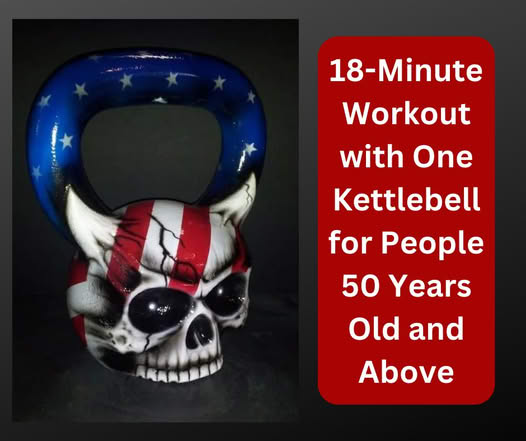
Designed specifically for individuals 50+, today’s 23-Min “Strength Interval” KB Workout combines kettlebell exercises and interval training to help you build strength, improve cardiovascular fitness, and boost your metabolism!
23 Min Strength Interval KB Workout for Over 50s
PART 1 – Set a timer for 1 minute. At the start of each minute, do the set number of reps. Rest for the rest of the minute. Do this 3 times:
— Single / Double KB Press x 8
— Single / Double KB Front Squat x 8
— Horn grab / Double KB Clean x 10
— Single Arm KB Row x 12 per side
— Total Body Extension x 20
PART 2 – Do as many rounds as you can of these exercises in 8 minutes:
— Friendly Burpee – 5
— Bodyweight / KB Walking Lunge w/ Balance – 8 per leg
What’s great about this offer is that when you grab my Over 50 Kettlebell Revolution program, you’ll also get Lifetime Kettlebell Fitness and the 28-Day Kettlebell Body Revival—both completely FREE.
…but this is the final run I’ll be doing of this special “3-for-1” deal.
And the best part? You only need a couple of kettlebells and 20-30 minutes for just three workouts a week.
You can do it all from the comfort of your own home!
With these programs, you’ll be able to:
Build functional strength, so you can keep enjoying all the activities you love.
Take care of your joints and stay injury-free during your workouts.
Boost your cardio endurance, which comes in handy for everyday life.
Improve your balance, reducing the risk of unexpected falls.
Enhance your bone health and prevent osteoporosis by increasing bone density.
Quick heads up — this is the last email I’m going to send about my 8-Minute Shoulder Fix being on sale.
Right now, when you grab it, you also get my Tactical 10-20-30 Kettlebell Plan included. It’s a solid deal, and if shoulder pain has been limiting your training, it’s worth a look.
A little background, in case you don’t know my story.
I played football for almost 15 years — high school, college, and a short run in the pros. I was a three-time All-American offensive lineman at UC Davis (a Division I FCS), and I had short stints in the pros with both Green Bay and Kansas City.
..and my shoulders got absolutely wrecked in the process 😉
Years of contact, years of heavy lifting, years of just “pushing through it”… like a lot of guys, I figured pain was just part of the deal.
But here’s what I eventually learned the hard way:
– Arm circles + controlled shoulder CARs 1 set of 6–8 slow reps each direction per arm
– Light kettlebell halos 1–2 sets of 8–10 reps each direction
– Kettlebell arm bars 1 set of 3–5 slow reps per side, or 30–45 seconds per side
– Tall-kneeling or half-kneeling kettlebell presses 1–2 sets of 5–8 controlled reps per side with a light bell
– Turkish get-up reps or partials 1–2 slow reps per side
#
Nothing fancy — just the right mix of mobility, stability, and activation.
Do this before your next kettlebell session — especially if you deal with tight or cranky shoulders — and you’ll feel the difference almost immediately.
And when you do it consistently, as we do in the 28-day Shoulder Fix, that’s when things really change. You could experience Less pain over time, better performance, and more confidence doing things like training hard without breaking down.
If this kind of work resonates with you, this is your window.
This is the last reminder about the discount, and the last chance to grab it with the Tactical 10-20-30 Kettlebell Plan included.
And yet, most people don’t realize they have a shoulder problem until it manifests as pain, clicking, weakness, or loss of strength in presses and pull-ups.
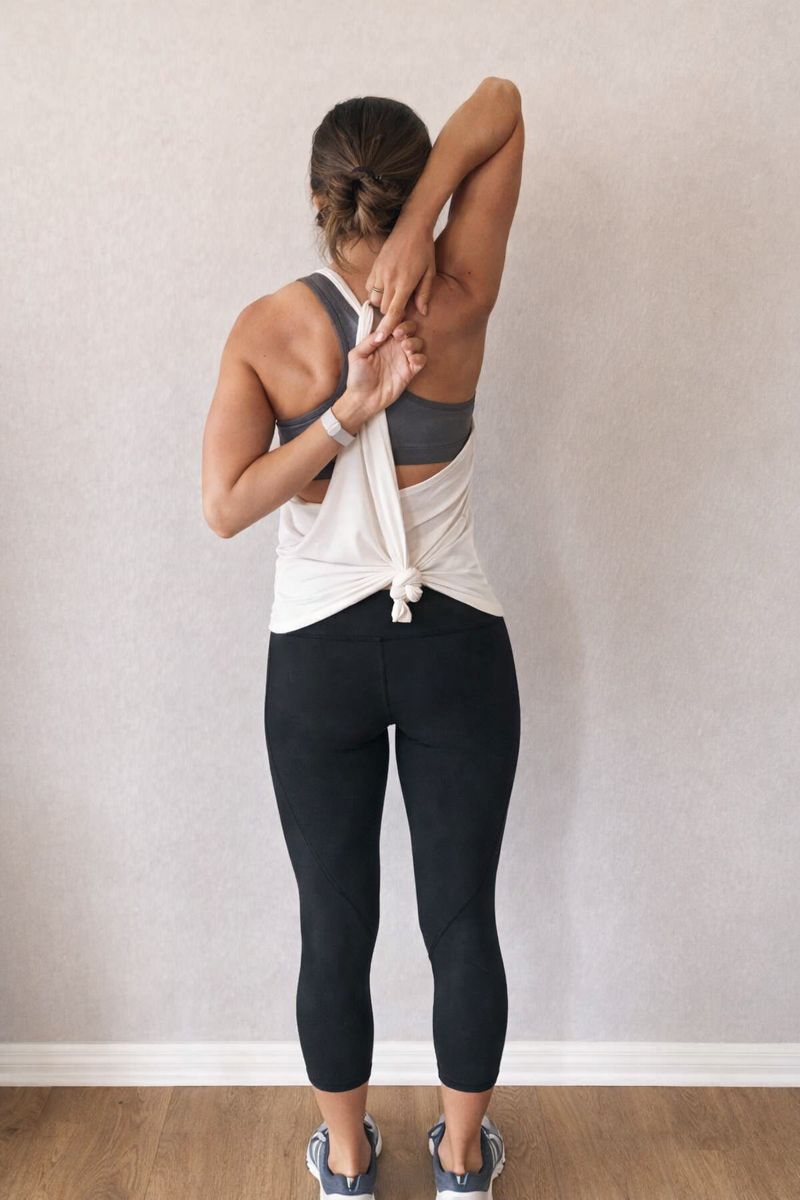
Today, I want to give you a quick-and-dirty shoulder flexibility test you can try right now.
This won’t tell you everything about your shoulders—but it’s an excellent starting point.
It takes less than 30 seconds and gives you real insight into how your shoulders are doing.
Here’s the test.
1 – Raise one arm overhead and reach down your back. 2 – At the same time, bring the other arm up behind your back. 3 – Try to touch your fingertips together.
Now, here’s how to score it:
— Excellent: Your fingers overlap — Good: Your fingertips touch — Average: Your fingertips are less than 2 inches apart — Poor: Your fingertips are more than 2 inches apart
What your result means:
— If the top arm felt tight, that usually points to limited shoulder flexion and tight triceps.
— If the bottom arm felt tight, that often indicates restricted shoulder extension and internal rotation.
If either arm was tight, you’re more likely to experience:
– Shoulder discomfort or instability during training – Limited range of motion in presses or pull-ups – Rotator cuff irritation – Shoulder pain or impingement over time
What to do next:
If you scored excellent, great work. Just remember—this test doesn’t evaluate strength or stability, which are just as important for truly bulletproof shoulders.
Those are things I specifically address in my daily shoulder routine.
If you scored average or poor—and you’re not actively working on this—now is the perfect time to start.
It’s a 28-day plan built for people who want to: – Relieve shoulder pain – Restore mobility – Train hard without limitations
It takes 8 minutes or less per day. No fancy equipment required. Includes follow-along videos and PDFs.
And this week, it’s on sale.
When you grab it, you’ll also get my 10–20–30 Tactical Kettlebell Program completely free as a bonus.
If you took the test and want a simple, proven way to improve your score, reduce pain, and protect your shoulders long-term, click here to check it out.
The 5×5 is a strength-training program originally popularized by Bill Starr in the 1970s. It has also had several more recent popular iterations and spins. The core of the program involves performing five sets of five reps of a chosen exercise to increase strength and size.
The 5×5 program is typically done using compound exercises such as the squat, bench press, and deadlift.
What I wanted to do, however, was take the spirit, energy, and time-tested results of this program—especially when it comes to building functional strength and lean muscle—and adapt it for kettlebells (since that’s kind of my thing).
The Kettlebell 5×5 has been a huge hit, so now I’m rolling out an updated version for 2026.
We officially start the program together tomorrow, Monday, January 12th. If you want to hop in and follow along with us in real time, you can sign up at the link below:
WARM-UP 30 seconds each, no rest. Complete 1–2 rounds:
– Arm swings / circles – Hip hinge / bodyweight good mornings – Bodyweight squats – Plank shoulder taps
PART 1 Do 5 reps of Exercise 1. Rest 60–120 seconds. Do 5 reps of Exercise 2. Rest 60–120 seconds. Alternate back and forth until you’ve completed a total of five rounds.
When you can complete five sets of five reps for each exercise, progress by adjusting tempo, reducing rest periods, choosing a harder variation, or increasing weight:
– Single or Double KB Press (5 reps per side) – Single or Double KB Swing (5 reps per side for single-arm swings / 5 reps total for double swings)
PART 2 Do 5 reps of Exercise 1. Rest 60–120 seconds. Do 5 reps of Exercise 2. Rest 60–120 seconds. Alternate back and forth until you’ve completed a total of five rounds.
When you can complete five sets of five reps for each exercise, progress by adjusting tempo, reducing rest periods, choosing a harder variation, or increasing weight:
– Single or Double KB Row (If no heavier weights are available, go to 10–15 reps) – Single or Double KB Squat (If no heavier weights are available, go to 10–15 reps)
PART 3 Perform as many reps as possible for each movement in 45 seconds. Rest 15 seconds between exercises. Rest 60 seconds between rounds. Complete 2–3 total rounds:
– KB halo + reverse lunge – Push-ups with alternating shoulder taps – Fast feet or high knees
Double Burpees (burpee with two push-ups after every rep)
#
Like the traditional 5×5 program, this is done as 5 sets of 5 reps per exercise, alternating between movements with structured rest periods, and progressing from workout to workout.
But unlike the traditional 5×5, we progress in one of three ways (since kettlebells tend to be more limited in weight selection and have bigger jumps between loads):
Adding weight, OR
Decreasing rest periods, OR
Using a slower tempo
This is just a small sample from one part of one workout from the full 5×5 Kettlebell Evolution program (updated for 2026). If you want to check out the full program, click the link below:
Not long ago, I ran a poll on my kettlebell page and asked a simple question:
Why do you work out?
The options were:
Aesthetics/appearance
Functionality/athleticism
Mental health
A lot of people checked more than one box—but what surprised me was how many people chose mental health as a major driver. Honestly, it may have been the majority.
You dial in your training, your recovery, and your nutrition. You get into a rhythm. You give your nervous system a break. And you give yourself a chance to feel better—not just leaner.
Inside the challenge, you get:
The Ageless Warrior Kettlebell Challenge
The Feed the Beast meal plan
The Regenerate recovery system
(If you bought those programs separately, it would cost more than the challenge itself. So even if you’re just buying into the idea and committing for the month, you’re already ahead.)
These workouts are designed to:
Release endorphins
Reduce stress
Help regulate hormones
Bring cortisol down instead of constantly spiking it
Every day includes a recovery component using my Regenerate sessions—mobility, flexibility, and pain management. And that matters more than people realize. Chronic pain and stiffness often drive people toward unhealthy coping mechanisms. When your body feels better, your decision-making tends to follow.
On the nutrition side, you’ll be using the Feed the Beast plan, which is based around intermittent fasting. That helps regulate blood sugar, supports long-term health and longevity, and—again—takes pressure off your system instead of adding more stress.
Below, I’ve included a sample workout from the Ageless Warrior Kettlebell Challenge. This is the exact training style you’ll be using inside the Sober Warrior Kettlebell system.
Give it a try.
And if it resonates, CLICK HERE to jump in—because today is the day we officially start.
— Forest
#
Kettlebell + Mental Health Workout
Do as many reps as you can of each exercise in 40 seconds. Rest for 20 seconds between moves. Rest for 60 seconds between rounds. Do 3 rounds total:
KB Goat Bag Swing -> 2 Hand KB Swing -> Single Arm KB Swing (20 seconds per side)
Plank hold -> add march
Alternating bodyweight lunge -> KB Tactical Lunge (alternate legs each rep)
If you’ve ever felt like workouts take too much time—or they’re so intense they’re impossible to sustain—I want to share one of my favorite conditioning methods: the 10-20-30 protocol.
It’s backed by research, incredibly effective, and actually doable.
Instead of constant all-out intervals, this method cycles effort levels so you get serious conditioning without burning yourself out. You work for 30 seconds at an easy pace, 20 seconds at a harder pace, and finish with a 10-second all-out push. Those built-in build-ups let you recover just enough to keep intensity high without wrecking your joints or nervous system.
Research shows that this style of training improves fat loss, cardiovascular health, blood sugar regulation, and even markers associated with conditions like hypertension and asthma.
Here’s a free sample workout using the 10-20-30 method—straight from one of the programs inside Firebreather Kettlebell:
#
19-Minute 10/20/30 Kettlebell Workout
Part 1: Strength & Power
Set a timer for 60-second intervals.
First 30 seconds: Comfortable pace
Next 20 seconds: Push the intensity
Final 10 seconds: All-out effort
Move straight to the next exercise. After completing all movements, rest 60 seconds. Complete 3 total rounds.
Dead-Stop Kettlebell Swings
– First 30 sec: Controlled swings, resting between reps – Last 20/10 sec: One-arm swings and/or kettlebell snatches
Push-Ups
– Start with standard push-ups – Progress to harder variations (incline, clapping, or diamond)
– First 30 sec: Bodyweight – Last 20/10 sec: Add kettlebell load
Single-Arm Kettlebell Rows
– Start light – Increase load as intensity rises
Jumping Jacks
– Easy and rhythmic early – Finish strong
#
This is exactly the kind of conditioning I rely on now—especially after years of hard training and a pro football career that left its mark on my joints. Kettlebells let me train hard, get my heart rate sky-high, and burn fat without pounding my body like traditional cardio.
— Forest Vance Master of Science, Human Movement Certified Russian Kettlebell Instructor RYT-200 Former Professional Football Player Founder, Forest Vance Training, Inc.
PS – If you want to dive deeper into the research behind the 10-20-30 method, you can check it out here: https://pmc.ncbi.nlm.nih.gov/articles/PMC11295100/#ejsc12163-sec-0060
5 KB Tactical Lunges – Right (16k women / 20k men)
5 KB Tactical Lunges – Left (16k women / 20k men)
10 1-Arm KB Swings – Right (16k women / 24k men)
10 1-Arm KB Swings – Left (16k women / 24k men)
10 total KB Plank Drag-Throughs (16k women / 20k men)
Complete 5 rounds for time.
#
As I’ve gotten older, this is the type of conditioning I rely on more and more:
— High output — High calorie burn — Joint-friendly enough to recover from and repeat
If this style of training clicks with you, I’ve got something worth checking out as you head into the new year.
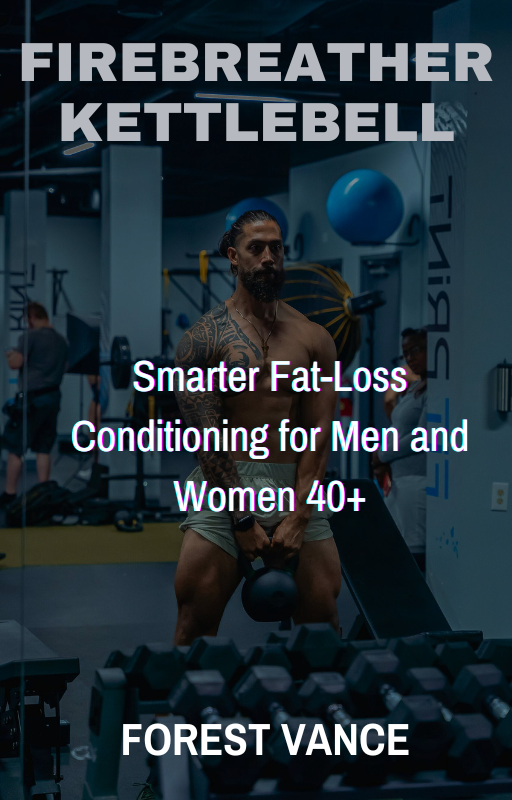
Firebreather Kettlebell is a fat-loss conditioning system for men and women 40+, built entirely around kettlebells so you can burn serious calories without pounding your joints or wrecking your body.
When it comes to fat loss and conditioning for those of us over 40, one of the most effective—and joint-friendly—approaches I’ve found is the 20/40 kettlebell protocol.
This method is featured in one of the programs inside my Firebreather Kettlebell bundle, which we’ve got on sale for the New Year. Firebreather includes 10 of my best kettlebell programs, all built around high-output conditioning without beating your body into the ground:
One of those programs is called the KB EMOM 20/40 Fat Loss Protocol.
Research by Paoli and others has shown that short bursts of very hard effort followed by longer recovery periods—especially when done with resistance training like kettlebells—can be more effective for fat loss and improving insulin sensitivity than long, steady-state cardio.
Instead of grinding nonstop, you hit it hard, recover fully, and repeat. That’s a huge win for anyone with tired joints, old injuries, or a body that doesn’t recover like it did at 25.
Here’s an example of what a 20/40 workout might look like:
This setup is different from traditional HIIT where you’re working longer with very short rest. That can work—but as we get older, it often becomes a fast track to feeling wrecked.
The 20/40 protocol lets you train hard, burn serious calories, and still recover well enough to show up strong the next day.
P.S. If you’re also looking to kickstart the New Year on the lifestyle side, we’re running a Dry January edition of the Sober Warrior Challenge starting Monday, January 5. It’s a 30-day reset from alcohol with structure, movement, mindset, and support. Details and signup info are available at the link if that’s something you’ve been considering: