The Turkish get up requires a high level of body awareness … it requires all of the muscles in the body to work together to accomplish the task … and it requires strong shoulders, hips, and core muscles.
And chin ups / pull ups are one of the best indicators of total body fitness. If you are a woman and you can do a few pull ups … or if you are a man and you can do 10 or more … you probably have a solid bodyweight-to-strength ratio, relatively low level of bodyfat, and good overall level of fitness.
Put these two moves together, and you got one heck of a total body workout!
Today we are on to part 2 of our FVT Kettlebell “Best Of” Series.
I am doing this post / article / video series because … in a recent reviewing / planning session … I realized that we have SO much great kettlebell – related content that’s been created over the years … that the vast majority of our audience hasn’t seen!
So today I have one of my most popular Kettlebell Challenge Workouts to share with you.
This idea came originally from workouts we do in our in-person boot camp classes.
Once per month, we do a kettlebell-based “Challenge” at FVT. These workouts are timed / scored in some way … and they serve as both a fun “test” – so see how fit you are – and also as a way to measure progress over time.
I posted one online and people loved it …
And the Kettlebell Challenge Workout concept was born! 🙂
And this particular one is one of the most popular I have put together.
My friend Travis Stoezel of Train Agressive took the Kettlebell / Bodyweight Ladder Challenge and got it on video … so I thought it would be a good example, to both see how to do the workout, and to see the intensity you’ll want to bring if you want to get the best possible results:
Kettlebell Challenge workouts like the one I shared with you today are a great way to both test your fitness and measure your progress over time.
Add them into your routine on an occasional basis for better long-term results.
Thanks for reading, and be back soon with part 3 of the FVT Kettlebell “Best Of” Series.
– Forest Vance
Certified Kettlebell Instructor
PS – The 28 Day KBs for Fat Loss Challenge is LIVE … and the program kicks off in just over 72 hours! Learn more and apply now at the link below:
I originally got certified through the RKC in 2009.
Since, I’ve worked with over 1000 in-person kettlebell clients …
I’ve led and assisted with kettlebell workshops locally, and all around the US …
And I’ve also written over 500 articles, shot over 200 videos, and created over a dozen products / home study courses … on the topic of kettlebells.
Man – when I list it out like that, it sounds like a lot! 🙂
Anyway … I woke up this morning … thinking about and planning our content creation for the coming month … and I thought … there is a LOT of great kettlebell – related content I’ve put out over the years, that the VAST MAJORITY of my audience hasn’t seen!
And that’s why I’m going to do a series of posts / emails / videos, highlighting some of the most popular content I’ve put out over the years.
Today we’re going to kick it off with one of my most popular videos. This one goes through a 90 second trick that has helped a LOT of folks with fixing the low back pain they’re experiencing from kettlebell swings.
Watch the video below:
And if it helps, would love to hear your thoughts!
Be back soon with part 2 of the FVT Kettlebell “Best Of” Series.
Any discussion about the fittest men and women in the world HAS to include “tactical athletes” at some point.
These folks have to maintain elite levels of fitness not as an option, but as a NECESSITY. Being out of shape for them could be a matter of life or death.
So it makes sense that we can ALL benefit from training in a “tactical style”. Balancing strength work, power training and high intensity intervals can get you lean, strong, and in top physical condition.
Today, I have a workout for you to try from Stew Smith. I found it on YouTube and thought it was a great example of a tactical fitness training. Check it out:
Watch the video that shows you how to do this workout here:
#
Can you see from that video how the tactical fitness approach can be beneficial to ANYONE looking to lose fat, gain lean muscle, and get into top physical condition?
Add today’s workout on one of your total body / metabolic conditioning training days this week, and feel the power for yourself.
To learn more about MY personal favorite “tactical fitness” training program.
Train hard, talk soon –
– Forest Vance
Certified Personal Trainer
Master of Science, Human Movement
ForestVance.com
PS – You might think video that plays when you click over to check out the Specforce Tactical Fitness System is a little over the top. I got a few emails back when we sent out a link to it yesterday. Personally – it gets me fired up 🙂 The PROGRAM behind it is SOLID though, I can tell you that – and it gets my stamp of approval.
The Turkish Get up is one of the BEST kettlebell moves around.
It requires shoulder stability and control, core strength, and leg drive – all things essential to lifting heavy weights and being an all-around strong-ass person.
BUT – it’s also one of the trickier KB moves to master, and is probably the one I get the most technique questions about.
So check out today’s video for and “unusual” tip to improve your Turkish get up.
Since it relates to me learning a routine for the first dance at my wedding … you’ve PROBABLY never heard of it … but take the 90 seconds to watch the video, and I think you’ll find it very helpful!
The hip hinging movement is something a lot of people struggle with.
It can be hard to both learn and coach. But it’s CRITCIAL to master before you even THINK about swinging a kettlebell.
Here is a kettlebell deadlift variation – called the Face Away from Wall Deadlift – that will help you nail the hip hinge:
Some coaching points:
— Set up facing away from the wall, with your heels approx 18-24 inches away
— The KB is set up between the feet, even with the insteps or even a little further back towards the heels
— Start the move by driving your hips back towards the wall
— The idea is to get that feeling of loading up the hips and hamstrings, pushing your butt backwards, and keeping the back flat
One of the best ways to use this is to do 5-10 reps of the drill right before you do KB swings. It will help you get into the groove and feel the movement pattern and the correct muscles to be using in the swing.
Again – when you do this drill – you are trying to “reach” your hips back towards the wall. Do NOT let your back round. You should have a nice straight line from your hip to your shoulder to your ear when you are at the bottom of the move.
This is one of the drills we use that proves HIGHLY successful to help people “get” the movement. So if you struggle with the hip hinge movement, try this drill today, and see if it helps.
PS – Want more help with your kettlebell training form? We have a few spots left in our 21 Day Kettlebells for Fat Loss Challenge, where I’ll work with you personally to do just that – details and submit your application here:
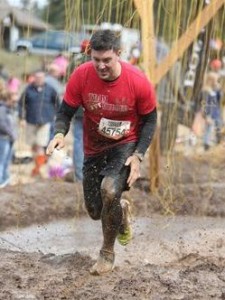
This Saturday, I am doing a Spartan Race with a group that we put together from FVT. We have been training hard together for the last eight weeks for the event, and I’m very much looking forward to it!
That being said, this may be my last participating in an event that involves running any distace for a while. I may very well be “retiring” from obstacle course racing.
You see – one of the big reasons my football career got cut short was because of problems with one of my knees. I had two surgeries on it in a six month time span. And my doc basically told me that I shouldn’t be running for any kind of distance – EVER.
The thing is, I really enjoy getting outside and training – so I basically ignored his advice 🙂
This was ten years ago – and in that time, I’ve done numberous 5k’s, 10k’s, sprint and Olympic distance triathlons, and Tough Mudders … but anytime that I do any sort of running any distance regularly, my knee just absolutely blows up.
So after this race, the plan is going to be to stick to hiking biking and some sprinting – but no distance running.
The other big thing I’m going to rely on to stay in top condition is kettlebell training. In a recent study, KB swings were shown to burn 20.2 calories per minute sponsored by the American Council on Exercise (ACE).
(For sake of comparision, using an online calculator I just found on SparkPeople.com, a 150 pound person burns 10.1 calories per minute running at a 10 minute mile pace – so the calorie burn from the KB swings is off the charts!)
Plus, if you know how to do swings with safe and effective technique, they’re a lot easier on the body than running, too.
Check out one of my favorite kettlebell workouts for fat loss, below:
#
Burpee – Squat – Swing KB Challenge Workout
*Men use a 24k ‘bell, women a 16k
1 burpee
2 goblet squats
3 swings
THEN
2 burpees
4 goblet squats
6 swings
THEN
3 burpees
6 goblet squats
9 swings
CONTINUE in the same fashion … increasing reps on the burpees by 1, goblet squats by 2, and swings by 3, each set … until you get to 10 burpees, 20 goblet squats, and 30 swings … and complete the full workout as fast as possible.
#
Whether you are in the same place that I am when it comes to running … or you just want to incorporate another cool training tool into your fat loss plan … I believe that KETTLEBELLS are THE way to go, when it comes to fat loss.
And if you liked this workout, stay tuned, because we have another FVT KBs for Fat Loss Challenge opening for registration … tomorrow!
The KB Clean is an exercise a lot of people have trouble with.
Got a video up for you with three tips to help you get better.
Check it out:
(video recap)
Improve Your Kettlebell Clean – 3 Simple Tips
1 – Think around getting your hand around the ‘bell
Most folks clean the KB up, but when it comes around their hand, it just kind of flops over the top and ends up smacking them in the wrist.
If you can think about getting your hand around the kettlebell instead, it will help you slip your hand around and finish in a nice strong position at the top.
2 – Think about zipping up a jacket
The motion your hand should be making is not unlike zipping up a jacket. Think about this next time you do the exercise, and it will help you keep your hand in the proper position.
3 – Land in the proper rack position
When the kettlebell is racked at the shoulder, this is called the rack position. You should 1) be able to touch your thumb to your collar bone 2) have the KB resting on your upper arm 3) also have the KB resting on your forearm when in the rack.
#
Give those tips a try at your next KB clean workout –
And see if they help.
Let me know how it goes, okay?
Talk soon –
– Forest
PS – Be sure to check out the Muscle and Fitness Giveaway we have going this weekend – 17+ free workouts for you on the page below:
The concept of “performance hacking” – that is, INSTANTLY improving your strength, flexibility, agility, balance, etc – seems almost unreal until you see it first hand.
I remember how blown away I was when I saw it demonstrated at my first KB cert in 2009.
Pavel took someone up in front of the 100+ person group … had them press the heaviest KB they thought they could … then fixed their breathing, had them focus on activating certain muscles when pressing, and couple of other things … and they set a 15+ pound PR right there in front of the group!
It was a jaw – dropping demonstration.
Now I have little “performance hacking” tricks that I’ve picked up over the years, that I use in training on a daily basis, that make a HUGE difference – you get instant results, and well as faster progress towards your training goals.
So I am excited to share an article and video with you today from a colleague of mine – Dustin Williams – who specializes in this idea of “performance hacking”.
Once I started realizing that we have to focus on so much more for each exercise than just the joints and muscles involved, my strength improved instantly.
Not only were my clients moving amounts of weight they never had before, my clients were seeing improvements in agility, flexibility, balance, and strength which was transcending into some amazing changes in the mirror and with daily activities.
The speed of the results was unmatched by anything they had previously attempted to achieve in a 4 to 6-week training program, and yet we were accomplishing this within a single session.
How was that possible?
With a pretty good working knowledge and understanding of how the body really functioned all together, I began to put several of these hacks all together at once.
My conclusion was that these hacks maximized a combination of training variables:
— Our Vision Plays A Huge Part In Movement
— Better Neurological Input = Better Output
— Bone Movement Needs Specific Rhythm
— Spinal Lengthening
— Shoes Affect Neurological Input
By using these variables in strength training, the body was forced to work more intensely, engage more muscles, adapt more quickly.
Check out this video that walks you through the “shoes for performance” hack:
The fact is, most resistance training approaches were lucky to address at best one of these variables …let alone all of them.
As a result, not only were my clients moving better and getting stronger, they were also still doing recreational things that they had given up on.
The reason no one else understood these benefits is that very few people were considering neurology to maximize strength and performance. That’s where Instant Performance Hacks comes in. The results are staggering.
Hope that sheds some light on why using neurology in resistance training has been so misunderstood and why it’s the missing link for so many people getting the results they want and deserve.
#
Really cool stuff, right?
Dustin is offering 40% off of his full Instant Performance Hacks until tomorrow at Midnight – check it out if it interests you at the link below:
Once you learn safe and effective technique in the KB swing, you can start to tweak and refine and make the exercise even BETTER – and take your fat loss and conditioning results to the next level!
The drill we’re going to walk you through today falls into this category of “next level” drills. It’s called the partner – assisted “overspeed” kettlebell swing.
(This is a short clip from a KB Workshop we put on and filmed recently at the FVT studio – if you like it and would like the full video footage of our Kettlebell Basics workshop – to learn from and study on your own – you can get it HERE for the next few days.)
As you’ll see in the video below, with this drill, instead of just letting the KB drop passively as it comes down, you’re going to actively accelerate it – with the help of a partner.
When you do this, you’ll get a faster, more powerful swing on the way back up. (I explain a bit more about WHY this works in the video.)
And you’ll eventually be able to use this technique without partner assistance – and as a result, improve your KB swing form.
Watch the video below, grab a partner, and give it a try today:
The Partner – Assisted “Overspeed” Kettlebell Swing
— Partner 1 is going to do a couple of swings by themselves
— After the swings, partner 2 will give them some help by giving the ‘bell a little push backwards
— Partner 1 does a few more swings alone and will try to get a stronger swing on the way up.
And a few reminders:
— Be in the front of your partner, not on the side. Pushing the kettlebell from the side will set your partners swing in a different direction.
— Watch your aim when pushing the bell back. You don’t want to force the bell to the ground, that will drive your partner down and stop the swinging motion. Instead you’ll want to guide the bell along the natural swinging path with enough but not too much force.
Once you’ve got the basics of how to do a safe and effective kettlebell swing down pat, the partner – assisted “overspeed” swing is a great drill to help you take your form to the next level.
Work it into your training, watch your form improve … and your fat loss results go through the roof!