The Swing is a movement that can almost always be refined. I’ve said this many times before, but mastery of the other basic balistic kettlebell moves (like the Clean and Snatch) all starts with the Swing. In this video with Senior RKC David Whitley and RKC Matt McBryde, you’ll learn:
Background and history of the kettlebell
Why ‘cushy’ shoes are a no-no for your kettlebell training
How to learn the ‘hip hinge’ and the proper swing movement pattern from the KB deadlift
Start here to learn the basic kettlebell exercises
Are you having problems mastering the basic kettlebell exercises?
Is your lower back aching after a KB training session?
Do you just feel like you’re not getting all you can out of your kettlebell training?
Good news: You’ve landed in the right place. This post is intended as a ‘jumping – off point’ for kettlebell beginners, as well as a reference resource for more advanced trainees. You’ll find detailed descriptions of each ‘basic’ kettlebell exercise (swing, Turkish get up, goblet squat, clean, press, and snatch), additional coaching points and technique tips for each, and much more.
Questions, comments, etc. are more than welcome – please leave them in the comments section at the bottom of the post and I’ll do my best to get back to you ASAP. Thanks, and enjoy!
– Forest Vance, RKC
Kettlebell Exercises
1. The Kettlebell Swing
The Kettlebell Swing forms the foundation of kettlebell training exercises. It hits almost all of your major muscle groups, with a special emphasis on the glutes, hamstrings, back extensors, and lats.
Your next foundational kettlebell training exercise – it hits all of the muscle groups that the Swing doesn’t. The Get-Up is considered a ‘grind’ (slow and controlled), in contrast with the Swing, which is considered a ‘ballistic’ (fast and explosive).
An exercise essential to the mastery of the basics of hardstyle kettlebell training. The kettlebell squat is different from, say, a traditional back squat; read the full article to find out more:
This is a video meant to aid beginners, those perfecting their form, or coping with an injury that explains two easy modifications to kettlebell workouts.
Also, if you liked this post, why not sign up for our newsletter? You’ll get tips and tricks just like these delivered straight to your email inbox – plus a couple of free bonuses just for signing up! Just enter your name and email into the box to the upper right of the page.
One awesome thing about mastering the basics of kettlebell training – the Swing, the Get Up, the Squat, the Clean and Press, and the Snatch – is that you can combine these exercises together into ‘flow’ combo circuits (see this post for more about the concept of ‘kettlebell flow’) once you’ve got them down.
So I’ve decided to do a short series of videos showing you how to do a few of these ‘kettlebell basics combos’. Here’s the first in the series:
To perform this combo, you’ll do 3 One Arm Swings, 3 One Arm Squat to Overhead Presses, and 3 One Arm Snatches, all continuously and on the same side (as shown in the video above).
You’ll then switch sides and complete the circuit again on the opposite side.
Complete ten rounds of this on the right and ten rounds on the left for a complete workout.
Enjoy!
One more thing: doing circuits like these requires mastery of the basic kettlebell drills first. You must have a solid grasp of the basic drills before you can start ripping them off in a circuit fashion like this. If you’re just getting started, here are two places to start:
1. Sign up for the KettlebellBasics.net newsletter and get 1. A Free Beginner’s Guide to Kettlebell Training and 2. Kettlebell Rx – a free KB training video. Just enter your name and email above to sign up today!
While most if not all of the ‘basic’ kettlebell movements hit the muscles of your back, the kettlebell row, and its different variations, will give you a direct shot to your lats, rhomboids, and middle/lower traps that should leave you sore for days if your form is on point. Let’s talk about how to perform a few different variations of this great exercise.
No different than a swing, the starting position must come from pushing the hips back behind you – loading up the glutes and hamstrings takes the stress off the lower back. The first and most basic version of the KB row is the two-hand variety. To perform this exercise, start with a wide stance and the hips pushed back. Both kettlebells will go between your feet. Start the movement by pulling both ‘bells up to your stomach. Make sure to visualize using your back doing the work and squeeze the shoulder blades together at the top.
The second version of the exercise is the one arm kettlebell row. You’ll start this one with a staggered stance and the kettlebell directly next to the front foot. Simply grab the ‘bell, row it up towards the same shoulder, and get a slight twist in your torso as the kettlebell reaches the top of the movement. Here’s a quick video demo of the exercise:
The third variation of the kettlebell row is the alternating version. This one is identical to the two arm row with regards to set up and positioning, except for the fact that we’ll be alternating arms – hold the ‘resting’ side’s ‘bell up to the body while you row with the other side.
The last variation of the kettlebell row is the ‘renegade’ row. This is much like a push up and row combined – this one is an awesome full – body smoker. This video provides a good description of the movement:
The row is a great kettlebell drill that can add some nice variation into your training routine. Try incorporating some or all of these variations of the drill into your existing program. Keep training hard and good luck!
If you enjoyed this post, make sure to sign up for our newsletter while you’re here and check out our free training video! Simply enter your name and email in the box in the upper right hand corner of the page for instant access.
Are you having trouble learning the kettlebell Snatch?
Does the ‘bell come around your hand and crash into your wrist, no matter what you do?
Is putting the whole movement together into a smooth, controlled, and efficient movement just seem to be getting the best of you?
Without a doubt, the kettlebell Snatch is a tricky move to master. So I’m here to help –
Based on what I’ve learned as an RKC and what I’ve seen teaching hundreds of folks how to do the exercise properly, here are 7 tips for a better kettlebell Snatch:
Mastery of the HardStyle Swing teaches you how to use your hips properly – and it also forms the foundation of all balistic moves in the HardStyle system.
2. No cork-screw
The kettlebell should flip over your wrist as it comes over the top, not rotate around it.
3. Be agressive
The more tentative you are about punching your hand through and finishing at overhead lockout, the harder the ‘bell will hit you in the wrist. So think about actively getting the hand around the ‘bell instead of letting it passively coming over the top of your hand as it flips over as you complete the kettlebell Snatch.
4. Keep the ‘bell close to the body
Think kettlebell Clean vs. kettlebell Swing. We’re trying to project the force up over our head in a Snatch and out in front of us during a Swing.
5. ‘Throw’ the weight down from the top
Attempt to close the distance from the elbow to the rib cage as fast as possible as the ‘bell comes down in front of you. This will also help you keep the ‘bell closer to the body.
6. Energy is driven from the hamstrings and glutes; load those babies up!
A high rep snatch workout should leave your posterior chain (that’s all the muscles in the back of your body) sore for days.
7. Learn the high pull
Create weightlessness with the hams and glutes. Then progress to High Pull – Snatch – High Pull – Snatch – etc. This is a nice progression that helps a lot if you’re having trouble getting the weight to flip over your wrist smoothly.
The Snatch can be one of the trickiest kettlebell exercises to master; put these seven tips to use and you’ll have it down in no time! Keep training hard!
Forest
P.S. Signed up for my weekly newsletter yet? You’ll get a free KB training video – ‘Kettlebell Rx: 3 common kettlebell training mistakes and how to fix them’ – AND a free copy of my ‘Beginner’s Guide to Kettlebell Training’ – when you do so today … just drop your name and best email in the box at the upper right of the page!!
Perfect swing form builds the foundation of more advanced kettlebell work. Perfecting your swings should be a continual process in your kettlebell training.
A recent email from Dan, a faithful reader of kettlebellbasics.net , provided some great feedback re: a recent training session we did. I’d like to share (with Dan’s permission, of course) a little of what he had to say with you today – these three tips will help a lot if you’re having trouble with your swing form:
“Btw, for your clients that are struggling with unlocking the hips (this is a key to being efficient with your swings) … these (three things have been the most helpful):
1. The Wall Squats. You told me to do two sets of ten and I have been doing those before the 15 minutes of swings on swing day. I have not even started picking up a ‘bell yet but the process of really pushing how low I can get without banging my face into the wall, my knees or failing backwards over my heels has helped a TON. It acts as a stretch too for that lower back/hip area.”
The wall squat is performed by facing a wall with your toes touching it, or least getting them as close as you can, and doing a squat. The key is to stay square, to make sure you don’t twist your body in any way, and to take care that your knees don’t shoot out and bang into the wall.
“2. The visualization of having the bottom of the ‘bell point straight behind you at the lowest point of the swing. Really helps get momentum for the upward swing.”
Think about getting the bottom of the kettlebell to face the wall behind you as you hike pass it back. This will also help you keep the ‘bell closer to the body throughout the movement, which makes for a more efficient and safer movement.
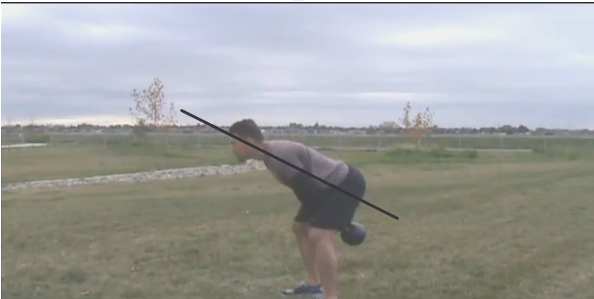
“3. The back definitely has to go forward, but it is straight and not rounded. I don’t look like this, but you should make sure your clients see something like this to help them visualize. With the stressing that the butt goes back and hips bend, its easy to forget that the back has to go forward at an angle. It was weird to watch you do your swings up close because it seemed so violent and quick. When the back is locked and pivots over at 45 degrees and back, it’s a quick violent motion. Definitely was eye opening.”
The main point here is don’t be afraid to let your body come forward; just don’t confuse a straight back with a flat back. In my experience, when people think ‘straight’, they think their body has to be straight up and down. Flat simply means this:
(Thanks for the screenshot from YouTube, Dan)
Just for a refresher, here’s a video I posted a while back about how to do a swing – take note of the things we’re talking about in this post happening during the exercise:
Keep working on your swing technique – it’s the foundation that much future training will be based upon. I hope these tips help accelerate your progress!
Want even more great tips and tricks like these to improve your kettlebell training technique? Pick up a copy of the KettlebellBasics.net Quick Start Guide – today’s your last chance to grab a copy at 50% off! Click here to order today.
The turkish get up is a move that, by comparison to some of the other kettlebell drills, is actually pretty easy to learn – one of the biggest issues seems to be figuring out the ‘proper’ way to do it. Do a quick YouTube search and you’ll get hundreds of videos and dozens of different get up ‘styles’ – everyone seems to be doing it a little differently.
While I’m not convinced there’s one ‘right’ way to do a get up, breaking the movement down into steps does seem to make the learning process a lot easier. Here’s one of the best YouTube videos I’ve found on doing just that:
To re-iterate (I’ve broken it down to 10 steps although the video only mentions 5):
Step 1: Safely bring the kettlebell to the shoulder and press it up over the chest.
Step 2: Right knee comes up if the KB is being held in the right hand.
Step 3: ‘Punch’ towards the sky with the kettlebell. Use your obliques on the right side and drive through the right heel for leverage. As you can see in the video, the movement is more like a roll than a sit up.
Step 4: Continue the movement and come up to the left elbow.
Step 5: Straighten the left elbow. The KB should now be at arms length in front of your body and the left arm should be straight – you’re resting on the left hand. You should be able to hold this postion for a while if you’re doing it right.
Step 6: Pick the body up. I like to do the RKC-style bridge here – but that’s not the version being done in this video.
Step 7: Swing the leg through. Keep looking at the KB.
Step 8: Come up to a knee. Go back and forth through these positions a few times while you’re practicing your form.
Step 9: Stand all the way up.
Step 10: Reverse the entire movment and finish laying on the floor.
This is a great demo of how to do the turkish get up. Breaking the movement down into steps is the best and fastest way to learn it – I know it helped me a lot when I was getting started.
Anthony DiLugo of artofstrength.com is demoing the exercise – find out more about him on his website. You can also check out his DVD’s and other info products on amazon.com by clicking here: The Art of Strength:Providence.
If you enjoyed this post, be sure to subscribe to the kettlebellbasics.net newsletter – just drop your name and email into the box in the upper right hand corner of the page. You’ll get a free KB training video just for signing up!
One of the hardest basic kettlebell exercises to master is the kettlebell clean. Although you’re more than likely to end up with a sore forearm while you’re perfecting your form on this exercise, there are a few points you can focus on to improve your technique fast. Check out this video for three coaching tips:
Don’t forget: you’ve got until 11:59pm Sunday night, the 24th of January, 2010, to enter to win a free copy of the KettlebellBasics.net Quick Start Guide! It only takes a minute or two … click HERE to leave a comment and enter to win.
If I do a Google search for ‘kettlebell swing’, I turn up with 923,000 results. A YouTube search comes up with 1,330. There’s a lot of information out there about how to do a kettlebell swing -and truth be told, there’s more than one ‘right’ way to do the exercise. I’ll cover three swing ‘styles’ in this post, and how each different style can be appropriate for specific fitness goals.
The first style I’ll cover is the hardstyle, or RKC swing. This is the swing style we teach here at kettlebellbasics.net. This style, put most simply, focuses on power production, not power conservation. It’s for increased fitness, not competition. Here’s what the hardstyle swing looks like:
In contrast to the hardstyle swing is the competition style swing. I’m by no means an expert on this style – but the basic premise is that this swing is designed for endurance and energy conservation – not for maximum power production or even fitness. As you can see in the video below, this technique is very different than the hardstyle swing. If you’re planning on competing in kettlebell lifting, this is the way to go:
The final swing variation is the ‘American’ swing or the CrossFit swing. This is a kind of ‘bastardized’ swing version that goes overhead instead of shoulder level like the hardstyle swing. I think you can run into some problems with this style; it’s easy to let the core go soft and it’s a lot easier to screw up! However, it’s true that the ‘bell does go through a larger range of motion, which could in theory let you get more work done in less time – thus increasing your power production. Here’s what it looks like:
There are quite a few different versions of the kettlebell swing. The bottom line is that each version we’ve talked about here can be useful for different goals – there’s no one ‘right’ way. If you’re going for improved power production and general fitness like fat loss and muslce gain, do the hardstyle swing. If you’re going to do competative kettlebell lifting, practice the competition style. I’m not really a huge fan of the CrossFit style swing – but it could have its uses. It’s up to you to decide the best method for you and your goals. Good luck and keep training hard!
The kettlebell squat is an exercise essential to the mastery of kettlebell basics. We’ll cover in this article what makes the kettlebell squat a killer exercise and the basics of how to perform it properly.
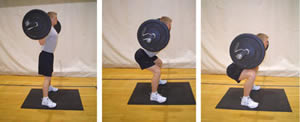
The mechanics of a kettlebell squat are a little unique; they differ slightly from, say, your traditional barbell back squat. Let’s take a look at each exercise for a starting point:
The Barbell Back Squat
The Kettlebell Squat
A close examination of body mechanics and position in each of these photos shows the difference between the exercises. Among other things, the placement of the weight in the front of the body allows the individual to keep the body more upright. The bar placement on the upper back in a traditional barbell back squat allows for the use of a greater load, but it also increases stress on the spine and knees. I’d go as far as to say the kettlebell squat is a superior exercise for your average person who lacks the flexibility, mobility, and core strength to perform a back squat with good form.
The movement is performed by sitting back like you’re sitting in a chair. The back stays flat, the spine stays lengthened, and the chest stays tall. Everyone is going to have a slightly different foot position, but a narrower stance than ‘typical’ is indicated. Most people will do well between shoulder and hip width apart.
You can integrate this exercise into your routine a lot of different ways – as always, practice the movement and perfect your form before you start plugging it into your regular workouts. Check out some past ‘workout’ articles on this blog for a few examples of how to work it into your routine.
The kettlebell squat is another one of the essential basic kettlebell drills. It’s a superior choice to other forms of the squat for many people. Take the time to learn the movement properly and you’ll be glad you did.
If you enjoyed this post, be sure to check out Kettlebell Rx – it’s a video on how to correct three common kettlebell training mistakes. And it’s yours free just for subscribing to the kettlebel basics newsletter!


 The Barbell Back Squat
 The Kettlebell Squat