Kettlebell Training: The Great Equalizer

There’s this guy that works out at the same gym as I do. I see him there every day mid-afternoon and he’s getting after it, throwing the weights around, training chest and biceps four times a week.

His passion and intensity level is inspiring; but I also know, because he’s a nice guy and I talk to him almost every day, that he wants to lose fat. And I know that there’s probably a more effective way to go about doing it than his current training system – to say the least.

My almost daily exposure to this spectacle has got me thinking: kettlebell training is like the ‘great equalizer’. Take someone who thinks they’re training hard, who’s training using this body part split, bodybuilding style workout, and have them do swings for 10 or 15 minutes. I’ve done it lots of times, and I know that this person gets smoked 9 times out of 10. In fact, most times they can’t make it the full 15 minutes.

On the other hand, I have female clients who are under 130 pounds that can do more swings and squats with a 24 kilo (53 pound) kettlebell than most men.

The point is, kettlebell training has a tendency of evening the playing field. If you think you’re in good shape, get someone who knows what they’re talking about to teach you the basics (or at the very least pick up a copy of the KettlebellBasics.net Quick Start Guide) and give kettlebell training a try.

And to help you learn more about the basics of training with kettlebells, here are a few posts from the archives to get you going:

The Swing

The Get Up

A Beginner Kettlebell Workout

Keep training hard!

Positives And Negatives Of YouTube For Learning How To Use Kettlebells

So I’m typically not one to say anything negative about other ‘fitness approaches’, if you will … with all the conflicting information out there, I think there’s a lot of perfectly fine ways to reach a goal, whether that’s gaining muscle, losing fat, etc.

However, I just wanted to give a quick example of what I’m talking about when I say that YouTube has some questionable instructional material with regards to kettlebell training … even when it comes to videos that have hundreds of thousands of views!  One of the main problems is that there’s some very good stuff on YouTube as well, and if you’re a newb, it can be hard to filter out the good and the bad.  If you will, let me know what you think about this particular video in the comments section of this post – I don’t think you even have to know much about kettlebell training to wonder wtf is going on here:

The moral of the story is to make sure you’re getting good, quality, qualified training advice.  If it’s kettlebell instruction you’re after, an RKC instructor is going to have the knowledge and experience to get you quality training and to help you learn the basic kettlebell movements safely and effectively.  ‘Nuff said.  To find one in your area, click here.

Kettlebells: The Perfect Extreme Cardio Tool

If you’re like me and you strongly dislike the more ‘traditional’ cardio methods – like the eliptical or the recumbent bike – kettlebells can be the perfect tool for an extreme cardio workout.  Let’s first define what cardio is, how you can get a great cardio workout using kettlebells, and then talk about what a cardio workout done with kettlebells would look like.

‘Cardio’, otherwise known as ‘aerobic exercise’, is defined by Wikipedia as follows:

“Aerobic exercise is physical exercise that intends to improve the efficiency of the cardiovascular system in absorbing and transporting oxygen.

[1] Aerobic means “with oxygen”, and refers to the use of oxygen in the body’s metabolic or energy-generating process.

Many types of exercise are aerobic, and by definition are performed at moderate levels of intensity for extended periods of time.”

So … can we use kettlebells to get a cardio workout?  Absolutely!  High rep swings, squats and sntaches get your heart rate up very quickly, and if you take minimal rest breaks, can keep it up for as long as you want.

So how would you structure a kettlebell cardio workout?  Those of you that have been training with kettlebells for any length of time can attest to the fact that almost every kb session tends to have a strong cardio element – but here are a couple of sample ‘cardio with kettlebells’ routines to really get your heart pumping:

1. Run and Swing

Those of you coming from a fighting background have surely done ‘road work’ at some point in time – here’s how to incorporate your kb:

1. run 400m/ 1 lap around a standard track or 1/4 mile fast
2. do 50 kettlebell swings

repeat this 4 times as fast as possible

Note: you can break up the swings if you can’t do 50 non-stop – but that’s the eventual goal

2. Kettlebell and Bodyweight 15’s

15 kb swings
15 burpees
15 kb clean and presses
15 sit ups
15 kb squats
15 push ups
15 kb snatches

repeat circuit 2x as fast as possible without rest

So there you have two kettlebell workouts you can do when it’s time for your next cardio session.  Both of these are short by traditional cardio standards, but many times more effective with regards to building true cardio fitness.

Now, if you want to take your cardio fitness to the next level, I highly recommend picking up a copy of  Viking Warrior Conditioning by Master RKC Kenneth Jay.  I can tell you first hand, this program is not for the faint of heart – but if you can make it thru, you’ll be in the best shape of your life.  Click below for more details and to grab a copy for yourself:

=>  Viking Warrior Conditioning The Scientific Approach to Forging a Heart of Elastic Steel: An Application of The Theory Behind Proper VO2max Training Kenneth Jay, Master RKC

And if you still need to master the basics of kettlebell training – which is required before taking on a program like Viking Warrior Conditioning – check out the KettlebellBasics.net Quick Start Guide by clicking HERE.

Enjoy these workouts and keep training hard!

A Kettlebell Training Staple: Gymboss Interval Timer Review


Gymboss Interval Timer

The majority of kettlebell workouts I do myself and with clients have a time component to them. Whether you’re keeping track of rest periods between sets, the length of your entire workout, if you’re doing as many reps as you can in a pre-determined amount of time, or if you’re doing a specific interval method like the Tabata protocol, having a reliable and accurate way to time yourself is essential.

A simple stopwatch is one solution, but it doesn’t give you much flexibility and definitely leaves a few features to be desired.  A great solution is the Gymboss Interval Timer.

There’s all kinds of cool stuff you can do with the Gymboss.  You can simply set a specific rest interval, hit the start button every time you finish a set, clip the device to your belt and set it to vibrate every time it’s time to go again – great for keeping your rest intervals consistent.  You can program a specific time interval, 30 seconds on, 30 seconds off, for example, and set up as many rounds as you want of this interval to lead you thru your workout (perfect for things like the Viking Warrior Conditioning program by Kenneth Jay).  You can even use it to learn to run – set up 2 min on, 2 min off intervals, for example, clip it to your belt, and run/walk every time the beeper goes off.  Decrease the walking interval and increase the running interval every workout until you’re running continuously for whatever amount of time you’re shooting for.  Your imagination is seriously the limit with this thing.

The only downside with the Gymboss is that it’s a separate unit you have to carry around – so it’s not as convenient as, say, a wristwatch. But in my opinion, for the extra features it offers, it’s well worth it.

You can pick up a Gymboss today by clicking here.  And if you have one already, I’d love to hear how you like it!

P.S.  To make sure you get all the latest from kettlebellbasics.net, make sure to sign up for our newsletter while you’re here – just drop your name and email into the box in upper right hand corner of this page.

7 Tips For A Better Kettlebell Snatch

The Kettlebell Snatch

Are you having trouble learning the kettlebell Snatch?

Does the ‘bell come around your hand and crash into your wrist, no matter what you do?

Is putting the whole movement together into a smooth, controlled, and efficient movement just seem to be getting the best of you?

Without a doubt, the kettlebell Snatch is a tricky move to master.  So I’m here to help –

Based on what I’ve learned as an RKC and what I’ve seen teaching hundreds of folks how to do the exercise properly, here are 7 tips for a better kettlebell Snatch:

1.  Learn and master the HardStyle kettlebell Swing

Mastery of the HardStyle Swing teaches you how to use your hips properly – and it also forms the foundation of all balistic moves in the HardStyle system.

2.  No cork-screw

The kettlebell should flip over your wrist as it comes over the top, not rotate around it.

3.  Be agressive

The more tentative you are about punching your hand through and finishing at overhead lockout, the harder the ‘bell will hit you in the wrist.  So think about actively getting the hand around the ‘bell instead of letting it passively coming over the top of your hand as it flips over as you complete the kettlebell Snatch.

4.  Keep the ‘bell close to the body

Think kettlebell Clean vs. kettlebell Swing.  We’re trying to project the force up over our head in a Snatch and out in front of us during a Swing.

5.  ‘Throw’ the weight down from the top

Attempt to close the distance from the elbow to the rib cage as fast as possible as the ‘bell comes down in front of you.  This will also help you keep the ‘bell closer to the body.

6.  Energy is driven from the hamstrings and glutes; load those babies up!

A high rep snatch workout should leave your posterior chain (that’s all the muscles in the back of your body) sore for days.

7.  Learn the high pull

Create weightlessness with the hams and glutes.  Then progress to High Pull – Snatch – High Pull – Snatch – etc.  This is a nice progression that helps a lot if you’re having trouble getting the weight to flip over your wrist smoothly.

The Snatch can be one of the trickiest kettlebell exercises to master; put these seven tips to use and you’ll have it down in no time! Keep training hard!

Forest

P.S. Signed up for my weekly newsletter yet?  You’ll get a free KB training video – ‘Kettlebell Rx:  3 common kettlebell training mistakes and how to fix them’ – AND a free copy of my ‘Beginner’s Guide to Kettlebell Training’ – when you do so today … just drop your name and best email in the box at the upper right of the page!!

Perfecting Your Swings: Kettlebell Training Basics

Perfect swing form builds the foundation of more advanced kettlebell work.  Perfecting your swings should be a continual process in your kettlebell training.

A recent email from Dan, a faithful reader of kettlebellbasics.net , provided some great feedback re: a recent training session we did.  I’d like to share (with Dan’s permission, of course) a little of what he had to say with you today – these three tips will help a lot if you’re having trouble with your swing form:

“Btw, for your clients that are struggling with unlocking the hips (this is a key to being efficient with your swings) … these (three things have been the most helpful):

1. The Wall Squats. You told me to do two sets of ten and I have been doing those before the 15 minutes of swings on swing day. I have not even started picking up a ‘bell yet but the process of really pushing how low I can get without banging my face into the wall, my knees or failing backwards over my heels has helped a TON. It acts as a stretch too for that lower back/hip area.”

The wall squat is performed by facing a wall with your toes touching it, or least getting them as close as you can, and doing a squat. The key is to stay square, to make sure you don’t twist your body in any way, and to take care that your knees don’t shoot out and bang into the wall.

“2. The visualization of having the bottom of the ‘bell point straight behind you at the lowest point of the swing. Really helps get momentum for the upward swing.”

Think about getting the bottom of the kettlebell to face the wall behind you as you hike pass it back. This will also help you keep the ‘bell closer to the body throughout the movement, which makes for a more efficient and safer movement.

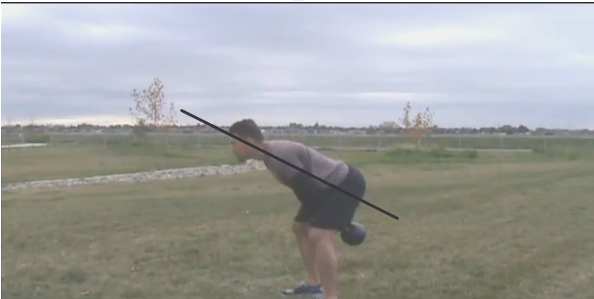
“3. The back definitely has to go forward, but it is straight and not rounded. I don’t look like this, but you should make sure your clients see something like this to help them visualize. With the stressing that the butt goes back and hips bend, its easy to forget that the back has to go forward at an angle. It was weird to watch you do your swings up close because it seemed so violent and quick. When the back is locked and pivots over at 45 degrees and back, it’s a quick violent motion. Definitely was eye opening.”

The main point here is don’t be afraid to let your body come forward; just don’t confuse a straight back with a flat back. In my experience, when people think ‘straight’, they think their body has to be straight up and down. Flat simply means this:

image001

(Thanks for the screenshot from YouTube, Dan)

Just for a refresher, here’s a video I posted a while back about how to do a swing – take note of the things we’re talking about in this post happening during the exercise:

Keep working on your swing technique – it’s the foundation that much future training will be based upon.  I hope these tips help accelerate your progress!

Want even more great tips and tricks like these to improve your kettlebell training technique? Pick up a copy of the KettlebellBasics.net Quick Start Guide – today’s your last chance to grab a copy at 50% off! Click here to order today.

Two Part Interview At lifeisntover.wordpress.com

Jeff over at lifeisntover.wordpress.com was nice enough to have me do a two-part interview about kettlebells on his blog over this last week.  Thought these interviews might be of interest to some of you – a few of the topics we covered:

-How the kettlebellbasics.net site got started
-My own personal kettlebell ‘mentor’
-Lessons I’ve learned from training with kettlebells
-Favorite kettlebell workouts
-Perfecting the snatch and clean
-What size KB to start with
-Proper length of a kettlebell workout
-The best brands of kettlebells

And a lot more! You can check out Part 1 HERE and Part 2 HERE.

Another quick heads up – if you’re on the fence about purchasing the KettlebellBasics.net Quick Start Guide, you’ve got until Friday night at 11:59pm PST to grab it at the promo launch price of 50% off – you can order it now by clicking here.

Enjoy the interview and let me know what you think!

How To Fix Your Kettlebell Clean

One of the hardest basic kettlebell exercises to master is the kettlebell clean. Although you’re more than likely to end up with a sore forearm while you’re perfecting your form on this exercise, there are a few points you can focus on to improve your technique fast. Check out this video for three coaching tips:

Don’t forget: you’ve got until 11:59pm Sunday night, the 24th of January, 2010, to enter to win a free copy of the KettlebellBasics.net Quick Start Guide! It only takes a minute or two … click HERE to leave a comment and enter to win.

3 Tips For Building A Solid Kettlebell Routine

Whether you’re trying to evaluate a pre-designed kettlebell routine or you’re attempting to design one yourself, you’ve got to have a way to determine if it’s going to be effective for helping you reach your goals.  While there are a lot of factors that can make or break a kettlebell routine, a detailed plan, focus on great technique and emphasis on the basics are three things that are very important components of a solid kettlebell routine.

The number one thing when evaluating a kettlebell routine is to make sure it lays out a very specific and detailed plan.  What you don’t want to do is just randomly piece together workouts from this blog or any other source; you want a complete program, such as the one(s) found in theKettlebellBasics.net Quick Start Guide.

Secondly, great technique is paramount. If you’re training with sloppy form, you’re not only shortchanging yourself on results, you’re putting yourself at a greater risk of injury.  Get some instruction, watch videos, study books (probably in that order of importance, too) to master the basics of safe and effective kettlebell training technique.

Lastly, focus on the basics.  You don’t need to be doing crecent swings or slingshots if you can’t do a basic swing or snatch; you truly can cover all of your major muscle groups by focusing exclusively on swings, get ups, clean and presses, squats, and snatches.

Having a specific and detailed plan, using great technique, and focusing on the basics are three of the most important things you can do when putting together or evaluating a kettlebell routine. If you want a guide to proper kettlebell training technique and a workout plan to go with it, check out theKettlebellBasics.net Quick Start Guide.  I put this guide together to solve the basic problems that so many people have when getting started with kettlebells.  Keep training hard!

P.S. While you’re here, don’t forget to sign up for your free KB training video – drop your name and email in the box in the upper right hand corner of the page!

New Training Video! Kettlebell Rx: Three Common KB Training Mistakes and How To Fix Them

I remember when I first started training with KB’s:  I had a lot of strength training experience, but the kettlebell was different than anything I’d ever trained with.  I was honestly surprised at the amount of technique involved.

One important thing to remember is that you have to take the time to learn proper technique with kettlebells before you really start seeing the benefits they can provide.  So I’ve created a video that goes over three super common technique problems and fixes.

I honestly think this video and the info in it will help you shorten the learning process considerably.  I go over troubleshooting the swing, the clean, and the snatch.

To get access to the video, just enter your name and email in the box up in the upper right hand corner of the page.  You’ll also get a free subscription to the Kettlebell Basics newsletter by signing up.  What could be better?  Sign up today to get on the fast track to fixing your beginner kettlebell training mistakes!